
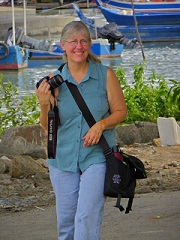
Since I started this journey about nine months ago, I have had the privilege to douse my toes in the Atlantic Ocean, swim with sea turtles in the Caribbean Sea, collect shells from a beach at the Gulf of Mexico, dip my hand in the Rio Grande River and ride the waves at the Pacific Ocean. Wow! What a privilege this journey has been, and it’s not over yet!
There is something that happens to me when I am on the water. I don’t know how to describe it… Maybe it has something to do with the expanse of the water stretching before me, the breeze (or wind) as we move over the water, or the feeling of weightlessness that I experience when I am in the water… I don’t know, but I really enjoy taking boats or ferries around coastal waters. Not so much farther out in the ocean where they become a bobber riding up the waves and dipping down the other side. I digress.
I learned about the Channel Islands National Park from a young man I met at the Petrified Forest National Park when we were comparing our adventures. His description intrigued me, so I added the park to my itinerary.
Channel Islands National Park is located of the Southern California coast across the Santa Barbara Channel between Santa Barbara and Los Angeles. I had considered kayaking around one of the islands, but the cost was prohibitive for just a couple of hours. My visit also fell on a day where I wasn’t feeling 100% so I chose to take a boat tour around Anacapa Island.
The history of the five islands in this archipelago is fascinating. The bones of a pygmy mammoth from 13,000 years ago were discovered on Santa Rosa Island in 1994.They are the most complete fossil of a pygmy mammoth in the world, and they revealed the diversity of the island terrestrial life was even greater than it is now.
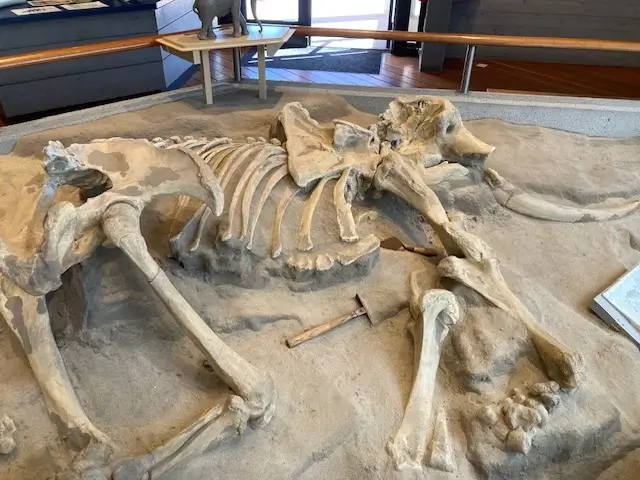
This diorama represents the dig site
Human history goes back about 13,500 years, according to archeological evidence, with the discovery of the oldest human remains found anywhere in the world. When the Spanish arrived, thousands of Chumash Indians called the islands home, but they were relocated to the mainland in the 1820s.
With the isolation from the mainland, the islands attracted ranchers since the early 1800s. A hacienda was established on Santa Rosa in 1844, followed by American ranches on other islands. In the early days, sheep was the favored livestock, with herds as large as 100,000 animals eating their way across the native landscape. One of the most diverse ranches, Rancho del Medio, was an island-wide operation on Santa Cruz. It produced beef, wool, olive oil, wine and nuts for export to the mainland.
That rustic life reached well into the 20th century, with some ranches continuing operation even after the islands were purchased by the National Park Service in 1980. Sheep continued to graze on Santa Cruz until 1984, while the last cattle roundup on the islands was held in 1998.
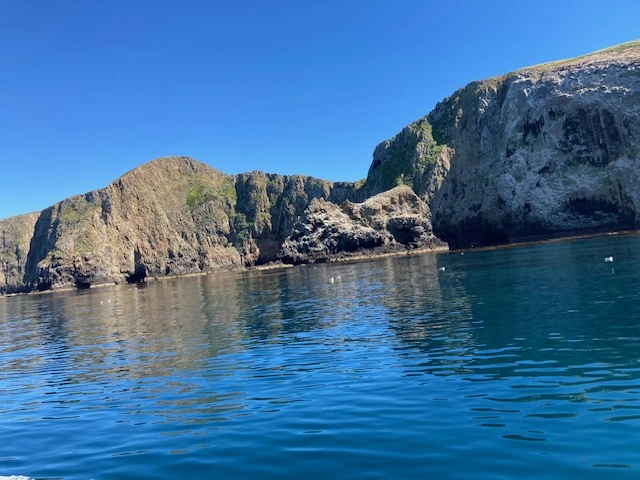
A seal lumbered slowly behind the boat as we were leaving the port, just one of the seals and sea lions we saw on the journey around Anacapa Island. Crossing the channel, riding toward the sun, there must have been a lot of moisture in the air. The sun refracting off the air left a glowing haze in the distance. We slowed down when we saw gray whale fluke trails, following the path, but the whales did not surface for us. I also noticed three ocean oil rigs. I thought it was interesting that they were so close to protected water and islands.
Anacapa Island is a narrow 5-mile-long set of 3 islets that are close together, yet inaccessible to each other except by boat.
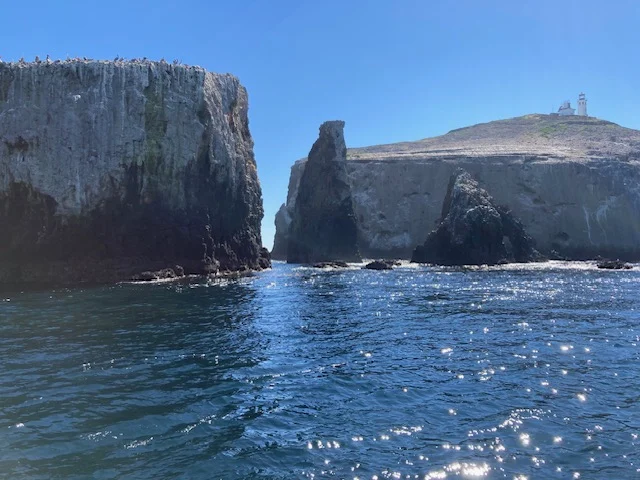
The naturalist on our boat was great! There are so many interesting facts around these islands, it’s hard to know how much to actually put in here. One thing I found really interesting is the ship wrecks. One went down in about 30 feet of water near Anacapa Island in 1853, with 32 other ships going down in the channel between 1850 and 1900. With the ship wrecks came stow aways. European black rats that reproduced and caused problems with the native species on Anacapa Island. In the early 2000s, a team of biologists collected the local mice and native species, keeping them safe, and then poisoned the area to get rid of the rats, after which they returned the native species. All non-native remnants of the ranching days, including horses, goats, etc., also were removed from all the islands.
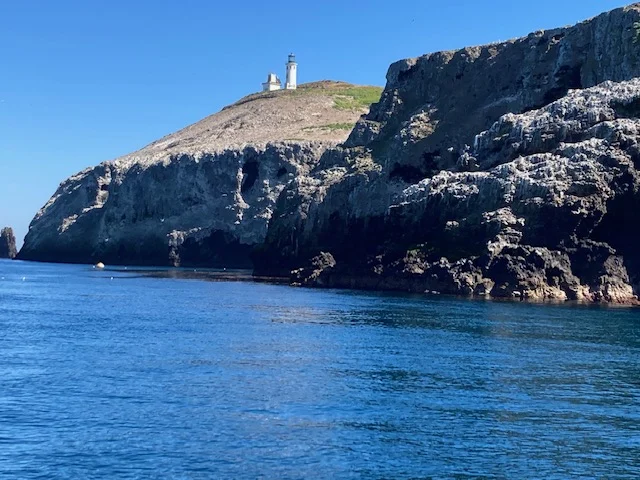
The lighthouse on Anacapa is the last lighthouse constructed on the West Coast.
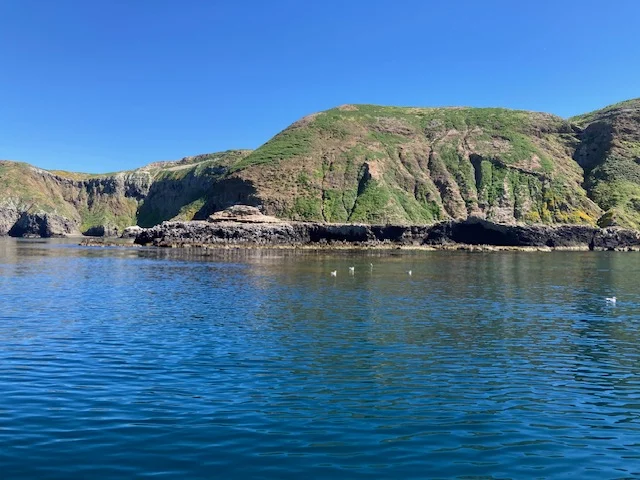
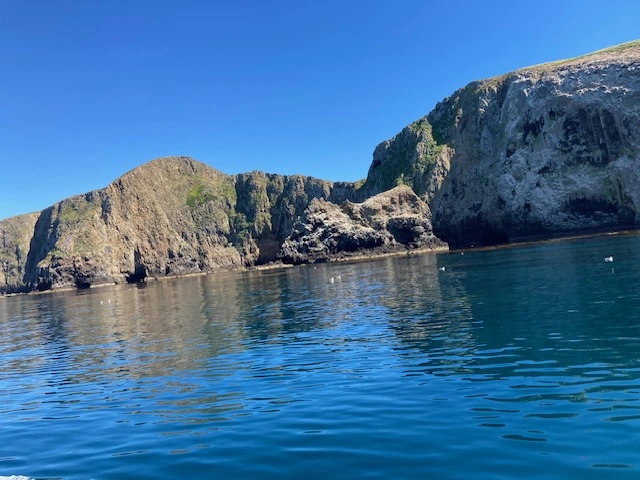
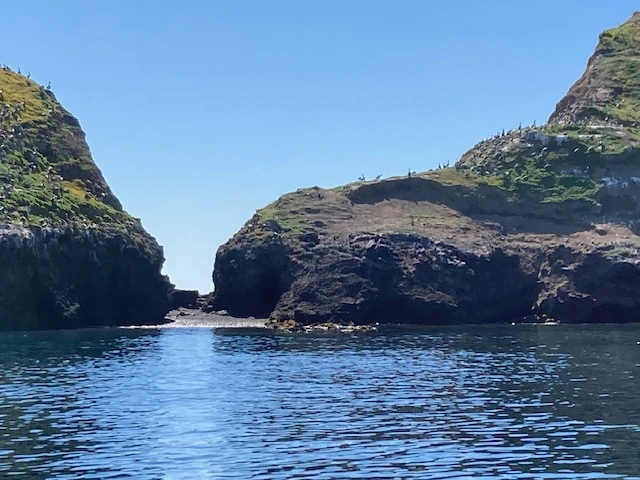
You can see all the pelicans up on the ridge.
On the way back, we had the privilege of watching three gray whales surface to breathe several times as we inched along with them on a parallel trajectory. Then they did a deep dive where they arch higher and then their flukes often raise out of the water as they dive. We had the privilege of seeing two raised flukes as they began propelling the whales deeper. It was exciting! I didn’t photograph it because I just wanted to experience it!
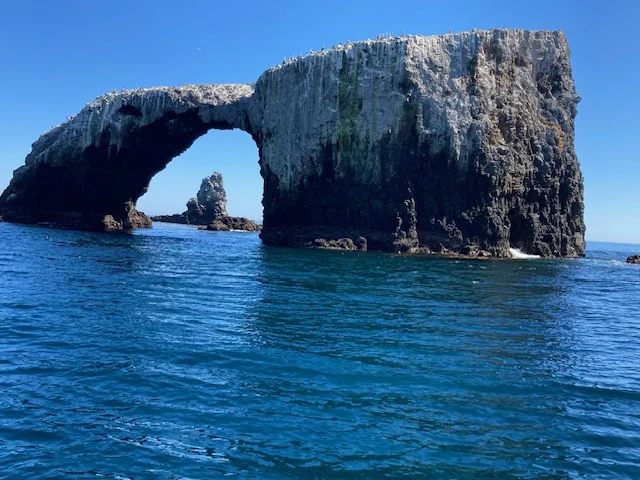
Arch Rock, a 40-foot-high natural bridge off the east end of Anacapa Island.
My trip to the islands covered such a small area. There are cliffs and caves to kayak to, hiking trails on the different islands, ship wrecks to snorkel or dive on, and many other ways to experience the beautiful quiet isolation of the islands, and the diversity of the species on and around them.