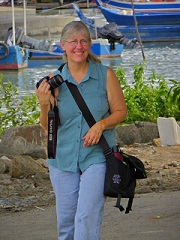

Louisiana. Where do I start with my adventure to Louisiana? I guess my adventure started with researching National Parks in the state. Did you know there is a National Park and National Park Visitor Center in the French Quarter in New Orleans?
The French Quarter, and the Mardi Gras, has always intrigued me, but I had only seen it in movies or shows. The architecture, and street musicians, and jazz, and art, and horse drawn carriages… And the cemeteries… I had to go, though I missed Mardi Gras by a couple of weeks. I’m really glad I went, but honestly, the city is a bit overwhelming for me. Especially the cost of parking!
Anyway, the only destination I had before I arrived was the French Quarter, so I really had no idea where I was headed. Then I saw a cemetery off the freeway entering town, so that was my first stop. It wasn’t the oldest cemetery in New Orleans, and no, it wasn’t the one where the voodoo queen is buried. You can only enter that cemetery with a tour guide. There are quite a few large cemeteries, and I can’t keep them all straight. Most of them have the above ground crypts. Did you know there is a distinction between a cemetery and a burial ground? At least there is in New Orleans! There are some in ground graves, and those areas are called burial grounds, while the above ground areas are called cemeteries.
The cemeteries I visited were very interesting, but I’ll describe those more later. I want to talk a bit about the French Quarter. My main objective was to visit the National Park Visitor Center and learn more about the Jean Lafitte National Historic Site and Preserve, and the New Orleans Jazz National Historic Park. It was closed. I arrived on a Sunday, and it didn’t open until Tuesday, so I did what anyone would do. I found things to do until it opened. I booked a city tour for the next morning and then walked along the Mississippi River on the New Orleans River Walk.

One of the sites from the River Walk near the French Market.
The city tour was really interesting. So many of the buildings were constructed in the 1700s and 1800s. Nearly all the buildings inside the French Quarter were built in the 1700s and they help hold each other up. Owners are not allowed to change floor plans, etc. and even need to get permits to paint. It is a thriving area that draws people from all over the world! It also is the only place in New Orleans where the roads make a lot of sense to me! The grid pattern is really easy to follow, and that changes a bit once you are outside the quarter, especially if you need to get off the freeways.

A French Quarter Street in the morning. These buildings have balconies, while others have what are called galleries. The difference between the two is the galleries are larger and are supported by posts rising up from the sidewalk.
One French Quarter gem I found is a small unique bookstore that sells books from historic books all the way to books published by recent authors, and local Louisiana authors, like Tom Robbins. Inside Crescent City Books locked glass cases house the oldest and most valuable books, while shelves lining the walls and center book cases hold a variety of ethnic history, each in its own section. The section for local authors is right near the door, along with books recently published. A treasure hunt for history buffs and bibliophiles. (I had to go in! And I have been visiting a lot of local libraries along the way. Who would have guessed?!)

One of my favorite places found on the city tour is the New Orleans City Park. I was told it is bigger than Central Park! I wound my way through the city back to the park, ate my lunch and then wandered.

This is in the City Park near the Lake.
The New Orleans Museum of Art (NOMA) is next to the park, and I had to wander through the sculpture garden. There are a lot of incredible sculptures invoking a variety of emotions.

I think this is my favorite sculpture. It is called “Overflow”, and is constructed entirely of alphabetic characters. It struck me a bit different than I think the artist, Jaume Plensa, intended because I was feeling a bit of information overload. It seemed appropriate that words and letters were pouring from me. Plensa’s work is fascinating, often looking at how language and communication affect us.

This sculpture gently flows in the breeze. The support is stable, and the pieces that look like feathers or wings move languidly in the breeze. It is beautiful to watch.
On Tuesday, I made it to the National Park Visitor Center and had the opportunity to catch a jazz concert! I was hoping to experience jazz while in New Orleans, and it was a blast. The New Orleans Jazz National Historic Park presents a free jazz concert with the rangers providing the music, often with added local jazz musicians. In fact, one of the rangers I was asking about the Jean LaFitte Barataria Preserve commented that he spends more time at the visitor center because he “likes to play his jazz”. He was the drummer that day. They also provide education along with the music.

The jazz concert with a local jazz brass instrument player.
Back to the cemeteries. On the city tour, we visited the St. Louis Cemetery #3, which has some fascinating history. It started in the late 1800s when the yellow fever outbreak killed about 4,000 people in New Orleans. They wanted to bury the people away from everyone else because of the contagions. So this cemetery began along the wall in the following picture:

One of the most interesting facts about the cemeteries is how the bodies are handled. If a crypt is meant to house lots of family members, the bodies are inserted in body bags, and the crypt is sealed. It cannot be opened for one year and one day. With the heat, the bodies are naturally cremated within that year and a day. There are some crypts, like the ones that hold the remains of the Catholic sisters or the priests, that have many, many names on the outside. Every one of those names represents remains in the crypt.


Leaving New Orleans, I drove down to the Jean LaFitte Historic Baataria Preserve and hiked the twin canals trail. Exiting my vehicle, Gary, whom I hadn’t met yet, pointed to a couple of alligators in the canal by the parking lot. We struck up a conversation and he ended up escorting me on the trail. We were joined by another hiker that Gary introduced as D, and later ran into a man named Jerry, who these gentlemen also know. Jerry is quite the jokester! The hike was a slow walk, stopping to both view nature and listen to the sounds. Gary grew up in the area and knew a lot of the history. The twin canals were man made, but many of the canals in the area are natural bayous. There used to be an oil rig out in the middle of the canals, and the use of the twin canals kept them clear of floating fauna. Now nature has taken over, and there are areas where the canals are blocked by floating fauna, or are turning into swamps.

A section of the Twin Canals Trail, which follows the land between two canals.
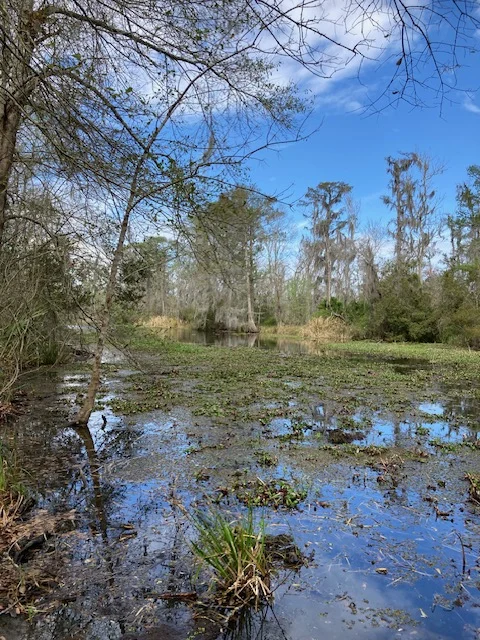
Here you can see the floating fauna on the canal.

The end of the trail.
We saw alligator slaying in the area that is turning to swamp on one side, along with a white egret and two limpkins. I had never seen limpkins before. Have you heard the sounds they make? They are as loud as a semi truck horn!
As we slowly hiked the conversations included me asking questions about the area, and the first-hand knowledge and information was great. The company was nice, and it was great to be in the woods.
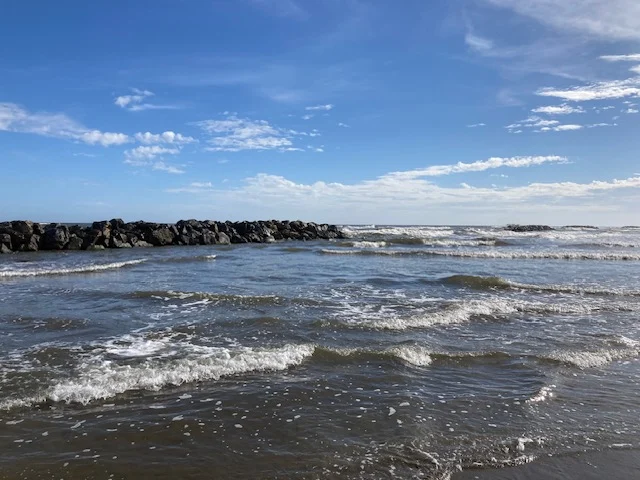
From there I headed down to Grand Isle State Park before leaving Louisiana. As the sun was moving toward the edge of the earth, not quite dusk, the beach was calming. The sounds of the waves and the squawking of the birds soothed my soul. The stone-piled segmented breakwaters added an interesting dimension to the wave sounds. You could hear the power of the waves building behind them, followed by the splash against them with the spray raising above them.