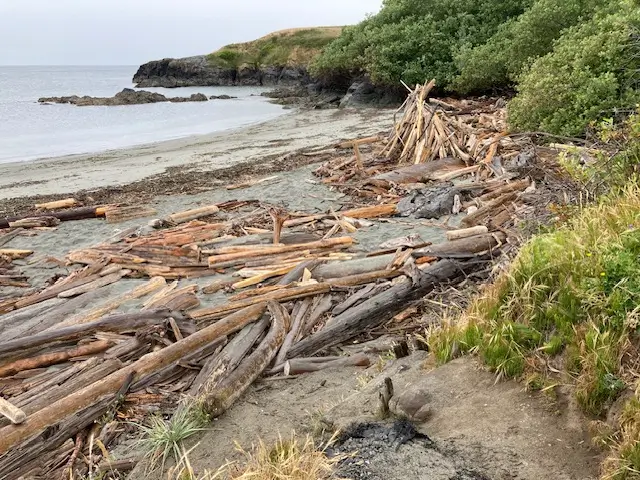
The rain seemed to follow me where ever I went! Though the San Juan Islands are more than 230 miles north of Mount Saint Helens, I spent another day in the rain!
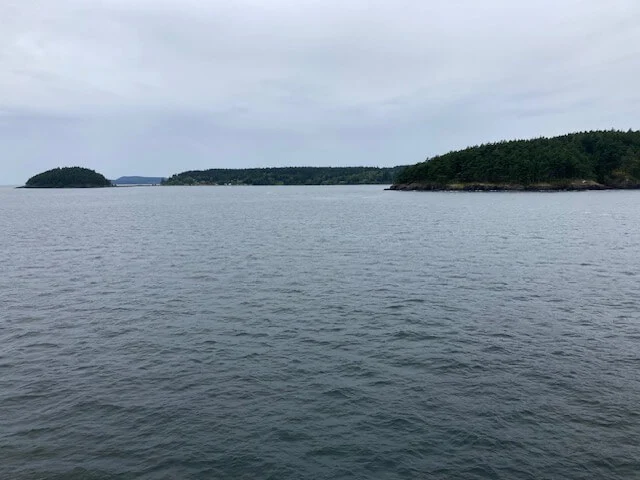
The San Juan Islands encompasses about 450 islands, rocks and pinnacles in the northern reaches of Washington’s Puget Sound, with approximately 1,000 acres of land spread across many of those included in the San Juan National Monument. I chose to visit San Juan Island, which is the second largest of the islands, and is renowned for whale watching. Getting there was quite an experience! I had never been on a ferry quite that large. Even when riding the ferries between Penang Island and Butterworth on the Malaysian mainland when I was living there didn’t seem that big.
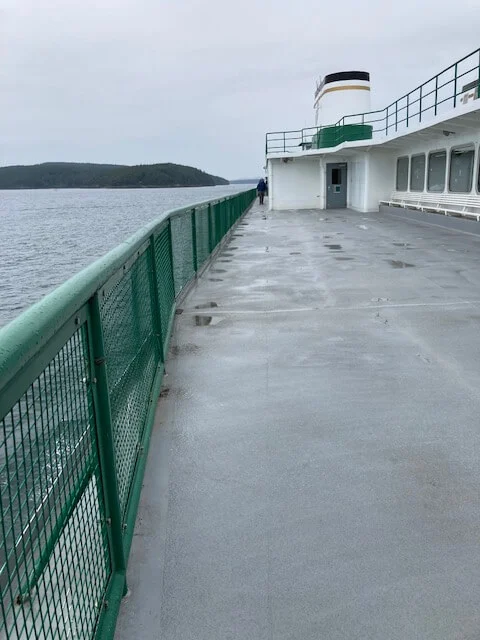
I was hoping to see a whale on the one-plus-hour ride to the island, but no luck there. We left the port and traveled around some of the islands to Friday Harbor. The ride was pleasant, and I did see some birds. Arriving at the port, I was lucky to be close to the front of one of the lanes with my vehicle which allowed me to drive off the ferry pretty quickly and head straight to the San Juan American Camp National Monument Visitor Center.
Have you ever heard of the Pig War? I hadn’t. It was a 12-year conflict between the United States and Great Britain spurred by an American shooting a Hudson Bay Company’s pig that was rooting in his garden in 1859.
The Northern Straits Region has been home to coast Salish peoples for thousands of years, including the San Juan Islands. The Pig War was the culmination of more than three centuries of contention over who would own the indigenous land and resources of the Pacific Northwest. An agreement had been reached in June 1846, the the Treaty of Oregon, setting the boundary on the 49th parallel from the Rocky Mountains “to the middle of the channel which separates the continent from Vancouver’s Island” then south through the channel to the Strait of Juan de Fuca and west to the Pacific Ocean. The treaty wasn’t clear enough on whether Great Britain or America owned the San Juan Islands, and both claimed the islands.
San Juan Island was first colonized by Hawaiian shepherds employed by the Hudson Bay Company in 1853, which is about the same time the Washington Territory claimed all the islands. The Belle Vue Sheep Farm was so successful that in six years it went from 1,369 to more than 4,500 sheep scattered in sheep stations around the island.
American settlers arrived in 1858, and by 1859 18 Americans had claimed stakes on prime Hudson Bay Company sheep grazing lands, which the British considered illegal and called them squatters and trespassers. When the pig was shot in 1859, the British threatened to evict all Americans as trespassers. The U.S. responded by sending a 64-man unit to the island that grew to more than 460. British troops were also being rallied.
One of the interesting things that was happening at the same time was the number of Black Californians fleeing to British Columbia after the federal Dred Scott decision in 1857. That decision allowed slave hunters to work in free states, like California, and also created second-class citizen rights for the Black population. At least four shiploads of Black Californians landed in British Columbia in 1858. One year later, 800 Black Californians were invited by the British Columbia governor to Vancouver Island with the hope their citizenship would help retain British power. At the height of the Pig War 40 to 50 Black men volunteered to serve on the Vancouver Island militia to protect the island in case of American aggression.
A joint military occupation agreement for San Juan Island was reached in 1860, which lasted for 12 years. The American Camp was on one side of the island and the British Camp was on another side. The boundary was settled in 1872 by a three-man German commission giving all the islands to America.
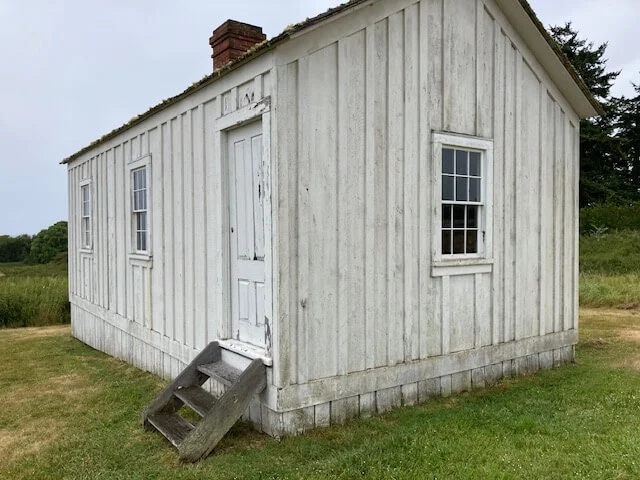
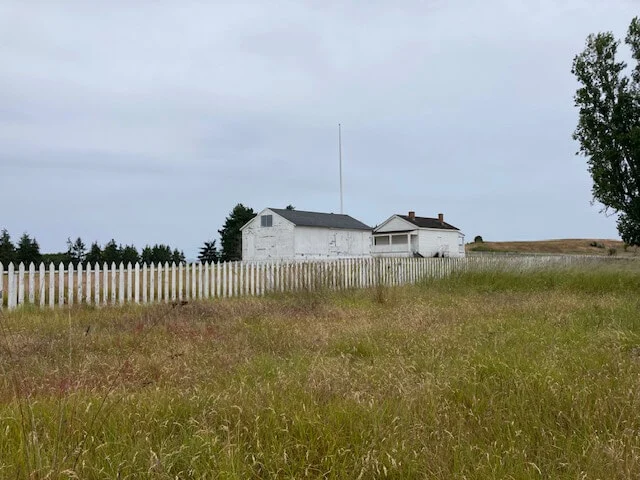
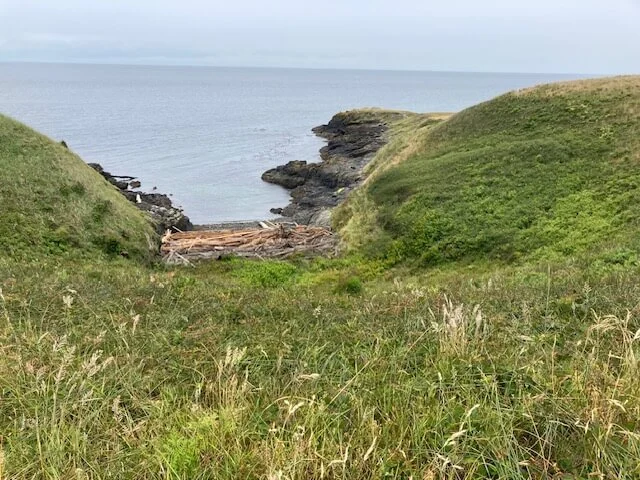
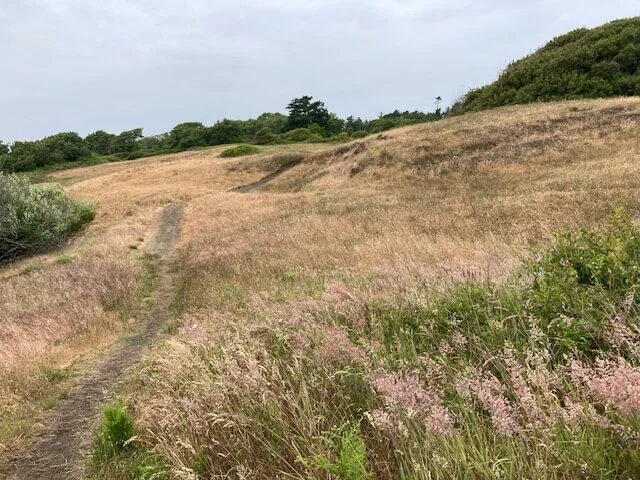
From the visitor center, I hiked through the woods and the coastal prairies out to Grandma’s Cove where I saw an eagle flying low from the lower side of rock outcrop to another. It was beautiful to watch, even from a distance.
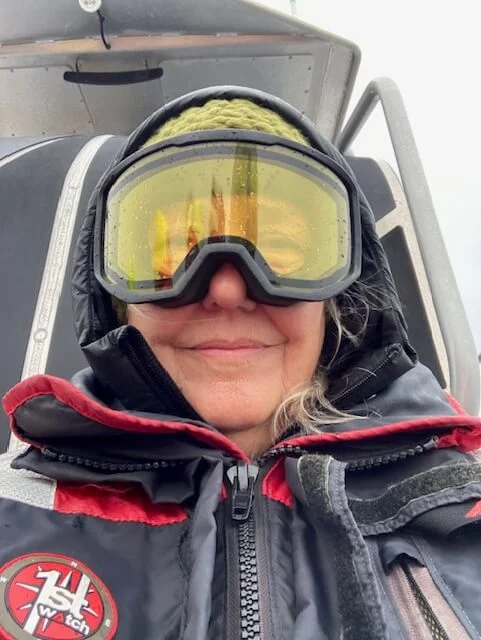
Then I went whale watching. The temperature, along with the rain, was already pretty cool, and being out on the water the temperature would drop another 20 degrees. Even with all the gear the whale watching company gave us, I was really cold when we got back from our three-hour excursion.
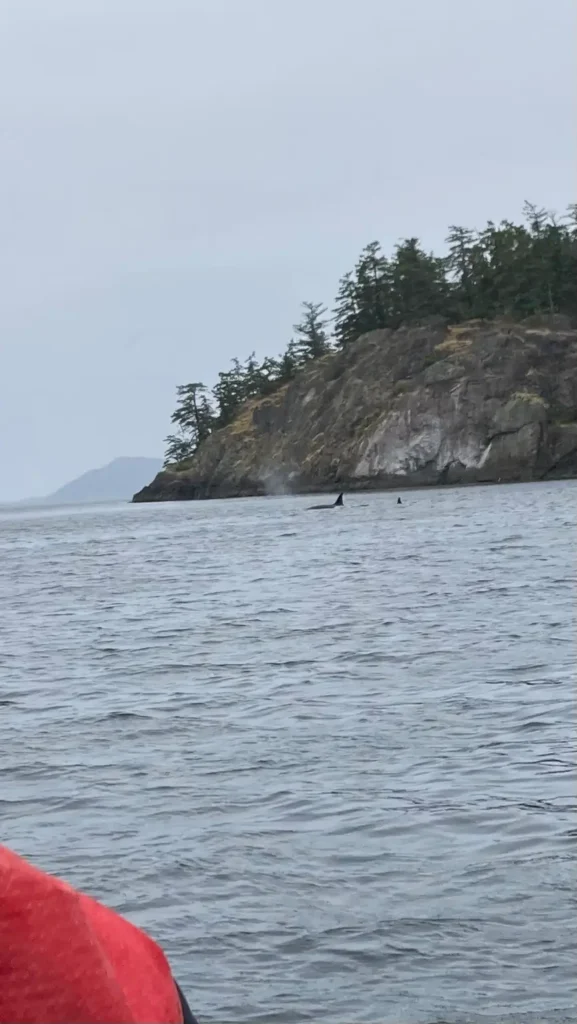
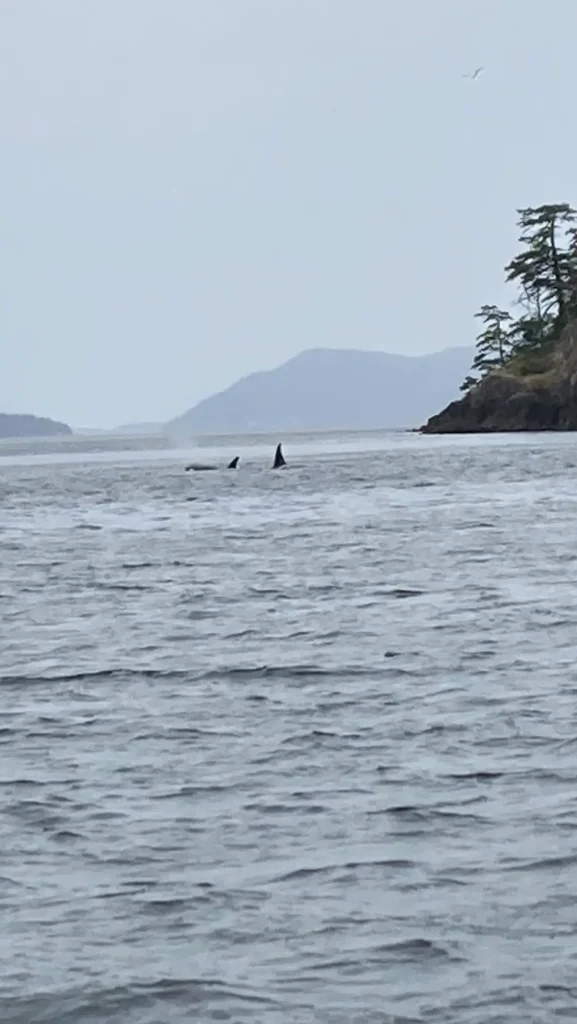
We were able to follow an orca family group for about 45 minutes, which was amazing! Did you know that orcas are very social, and that orca communities are matriarchal? The lifespan of a female is about 50 years. The babies nurse for a couple of years, but they often stay with their mother their entire life. Once a female has a baby, which doesn’t happen until she is between 12 and 15 years old, she has the choice of staying with her mother’s family group or starting one of her own.
Orcas are so interesting! I had no idea that newborn orcas are not black and white. They are black and orange.
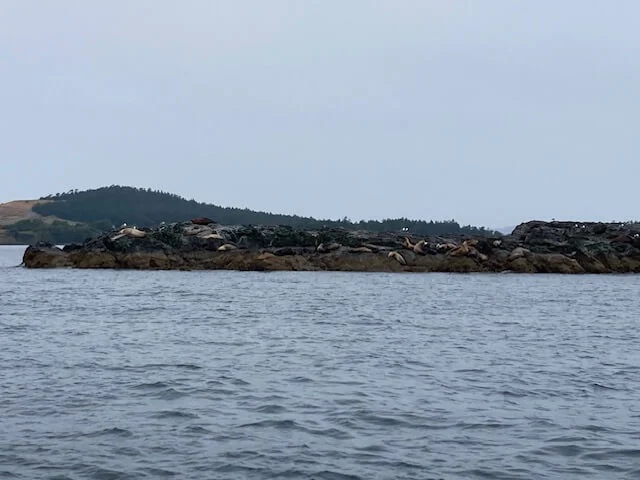
I wasn’t able to get any real good photos of the whales with my phone in the rain. I kept my binoculars tucked in my jacket except when I was watching the whales or looking at the Stellar sea lions, harbor seals or birds.
I will leave you with a couple more photos. I’m really glad I was able to go on this adventure, even though I got so wet and cold!