
Though fossil records show these giants once grew naturally in many areas of the Northern Hemisphere, through climate and environmental changes they now only grow naturally in a 40-mile-wide-by-450-mile-long swath from southern Oregon to southern Monterey County, California. They are so immense, they live in three climatic zones – the base in one set of conditions, the stem in another, and the crown in another. It can be cool and moist at the base near the ground, and, in complete contrast, dry and windy at the crown.
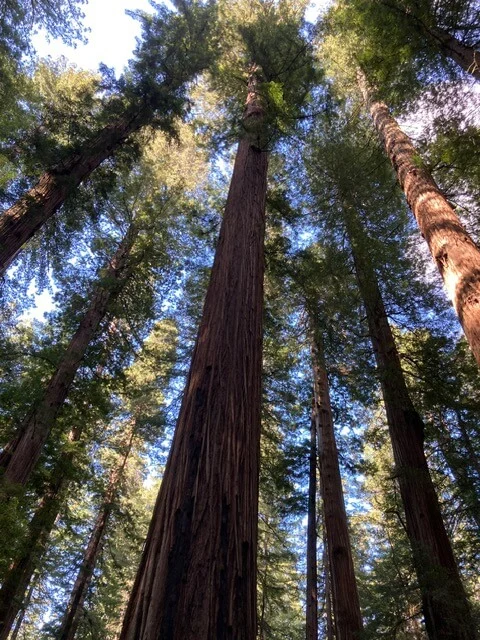
These giants, the coastal Redwoods, are the tallest known trees in the world, with the Dryerville Giant measuring more than 362 feet tall before it fell in 1991. That is comparable to a 30 story building in height! Did you know these magnificent trees can live up to 2,000 years?
As a tree person, (my ex-husband used to tell me I was a tree in another life), I have always wanted the experience of standing near these incredible trees. Spending four days in the Redwood forests, I was finally able to do that, first at the Avenue of the Giants in Humboldt Redwoods State Park, and then at the Redwoods National and State Parks.
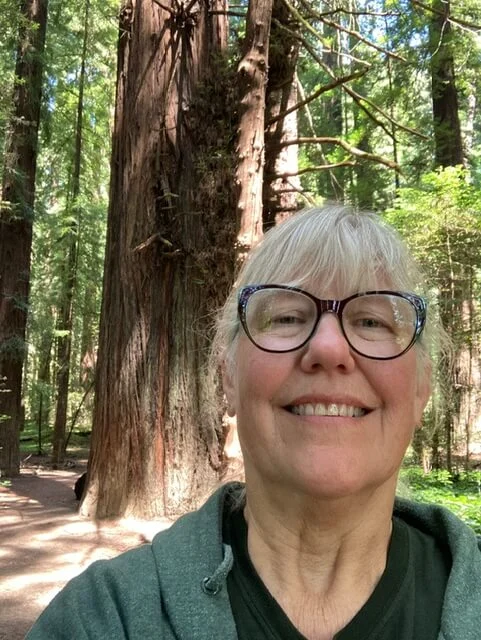
Stepping into the forest was like stepping into another world, a fairy world of towering trees, fallen giants, and ferns. The sun stretched its arms reaching through the canopy painting golden spots on low growing greens as a slight breeze whispered through the trees. A bird I couldn’t see announced my presence as I hiked. It was magical, and images kept floating in my mind of me laying on the ground to heal… to be… to be still… to be part of the forest. It is hard to explain how I felt in the forest. Like I belonged, and I wanted to stay there, to lite a campfire and sleep amongst the trees in my car. But the campgrounds inside the State Park were full.
The Avenue of the Giants has an auto tour with eight stops along the 32-miles. It is recommended to spend at least four hours, but I spent the good part of two days checking out the stops and hiking. I am not a fast hiker by any means. It’s not that I can’t hike fast. It’s that I stop to study so many things.
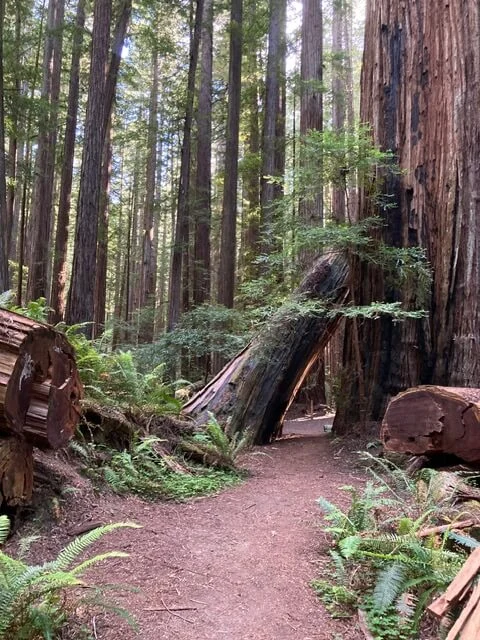
There are several different Redwood groves along the Avenue, but honestly, I couldn’t really tell where one ends and the next begins! Education about the Redwoods and their preservation, both historically and currently, is sprinkled throughout the forest on signs at the different stops and at the visitor centers. There is a booklet with information that correlates with 12 stops along a half-mile flat trail inside the Founders Grove.
One of the most fascinating things I learned is that the greatest accumulation of biomass (living and dead organic material) ever recorded was in one of the Redwood forests in Humboldt Redwoods State Park. This temperate rain forest has seven times the biomass as that found in a tropical rain forest!
Redwoods help create their own microclimate through transpiration of moisture. What that means, is some of their lower needles are flat on the surface to catch more of the sunlight and absorb moisture from the fog, while other needles in the canopy are round to protect the moisture. The trees need a lot of water, and some of the needles absorb moisture, while others funnel the moisture into drops to disperse on the ground. Once I learned that, I had a greater understanding of the fog rolling in off the ocean all the time. The Redwoods are right where they need to be. The fog is their lifeline!
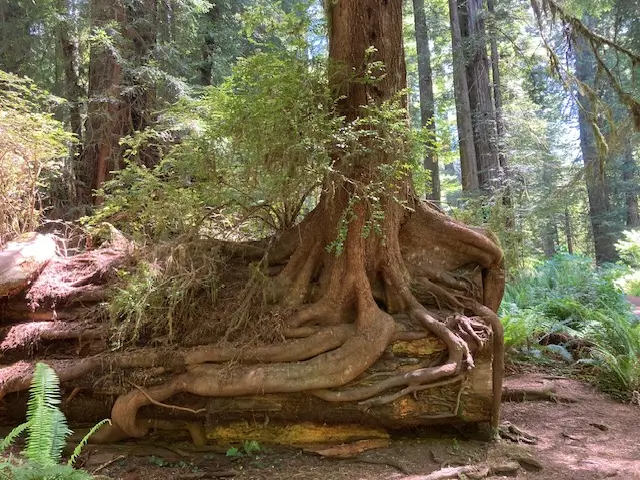
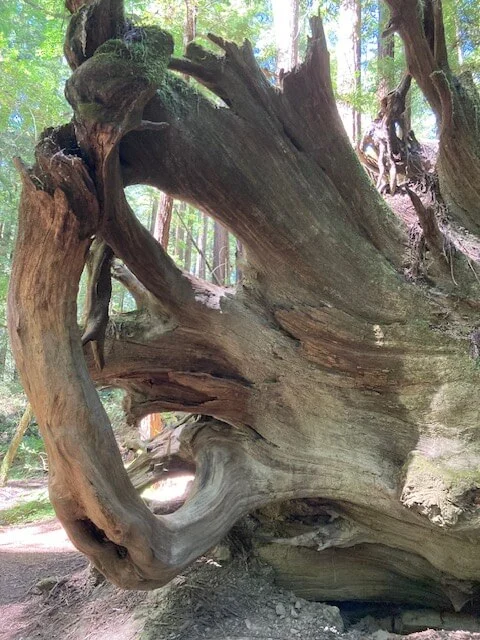
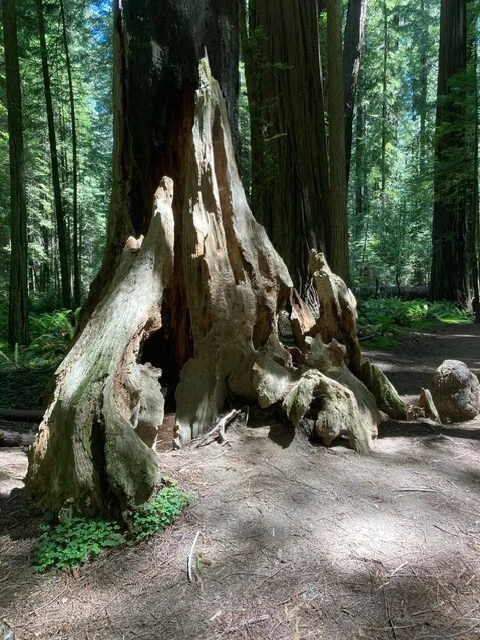
The roots of a Redwood are shallow, but they may stretch out hundreds of feet in all directions, intertwining and gripping other tree’s roots to create stability for all of them. What makes a Redwood fall is usually either waterlogged soil or being knocked over by another tree that falls.
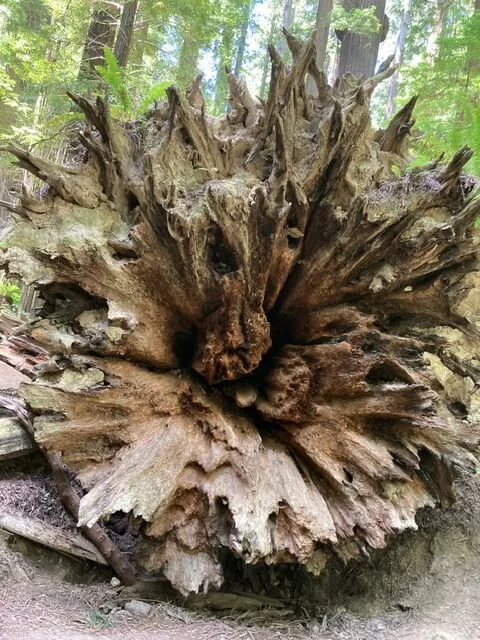
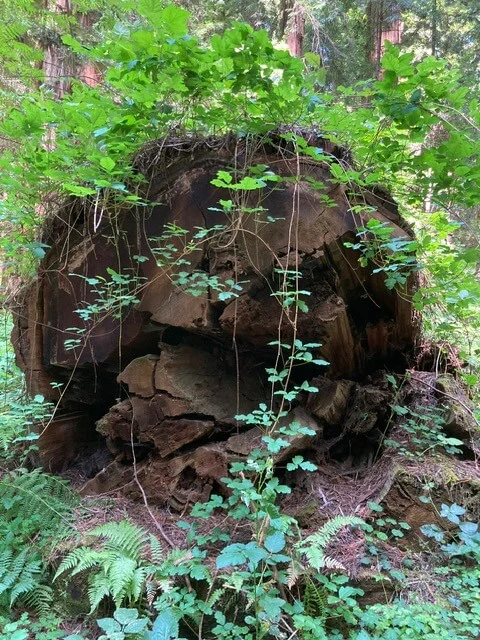
Once a Redwood falls, it may take 400 years, or longer, for it to become incorporated into the forest floor. These sleeping giants are called nurse logs because they are an integral part of the forest ecosystem. An estimated 1,700 species of plants and animals depend on a tree throughout its life span, with more than 4,000 species living in or on a downed log.
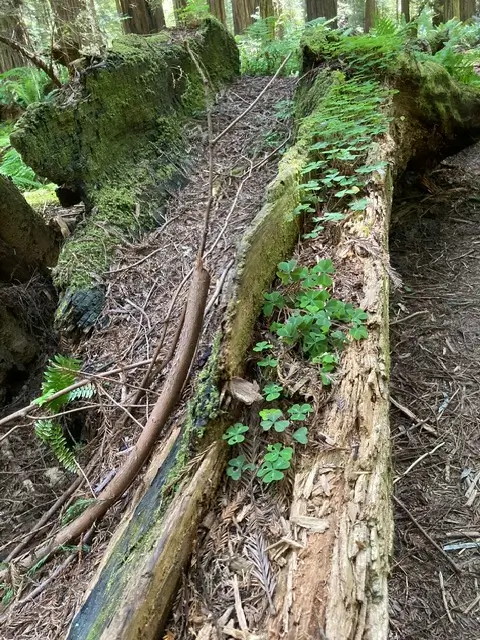
Did you know there are plants and animals that live their entire lives in a thriving suspended ecosystem more than 250 feet in the air in the Redwood canopies? The entire life cycle of some rodents, insects and amphibians is spent within high-elevation fern mats and mossy hollows. Sonoma tree voles, arboreal mites and springtails, spiders, wandering salamanders, to name some. And did you know wandering salamanders do not have lungs and breath through their skin?
From the Avenue, I headed up to the Redwood National and State Parks. The National Park not only protects the Redwood Forest, it also protects 37 miles of pristine Pacific Coast, wild river and streams, wildlife, and historical relics. The 131,983 combined National and State park acres was born out of controversy between logging the magnificent giants and saving them. The battle began shortly after World War 1 when people realized the need to save some of these old growth forests. A group of prominent men visited the area in 1917 and then created the Save-the-Redwoods League. In the 1920s, with state and private funds, the League purchased tracts of land that became State Parks.
The controversy started up again in the 1960s, and after the tallest tree on the planet was discovered by a National Geographic team in the Tall Trees Grove, the attention expedited the call for federal protections. The Redwoods National Park was established in 1968. It wasn’t until 1994 that the agreement was signed to manage the Jedediah Smith Redwoods, Del Norte Coast Redwoods, and Prairie Creek Redwoods state parks, with Redwoods National Park.
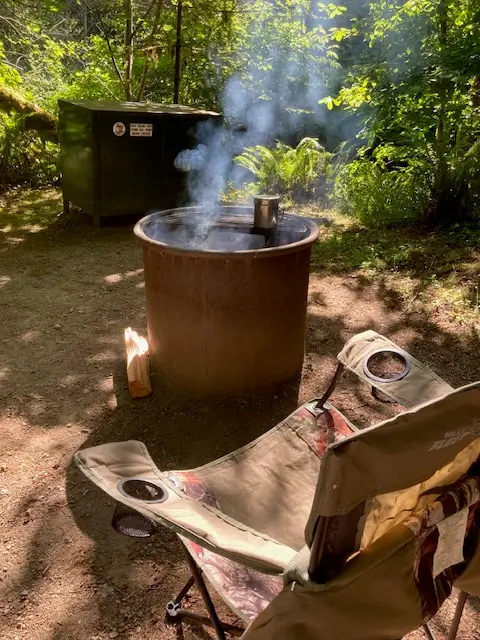
I was able to spend two days in the National and State Parks, and yes, I did camp overnight in the forest! It was at the Mill Creek Campground out in the middle of nowhere, driving down narrow squiggly U-turn roads, and it was amazing! It was the first time I camped where bear safes were provided for the food, and I was told a bear would enter the campground on a regular basis, “but I haven’t seen it the last couple of days,” she said. In some ways it was more work than staying in a hotel because I had to put anything that had a scent, whether it was food or personal care items, in the bear safe.
The huge old-growth redwoods at the Grove of Titans was a totally different hike. To protect the shallow roots of the trees, platforms have been constructed on much of the trail, especially around the largest trees. It creates a different type of level trail with stairs. There also is a creek that runs nearby, creating the calming ambiance.
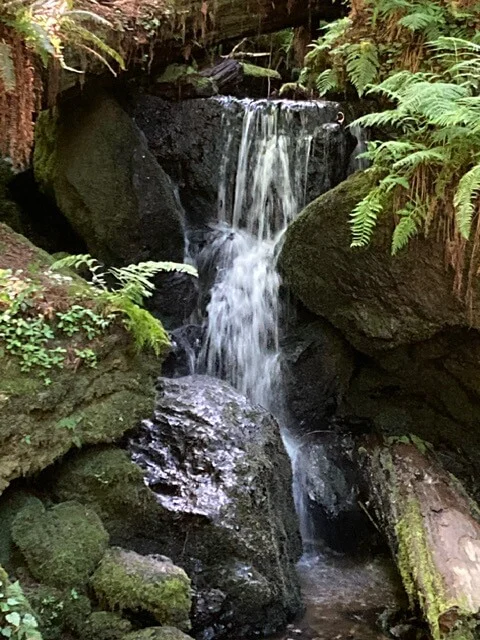
Hiking alone in the forest was sometimes a little scary. When I was heading to Trillium Falls, there was a sign at the trail head that a bear had been spotted nearby, and if I remember correctly, there also were cubs. It did not recommend hiking alone. I nearly went back to my car, but a large family group headed up the trail, so I just tagged along. I am so glad I did! It was incredible!
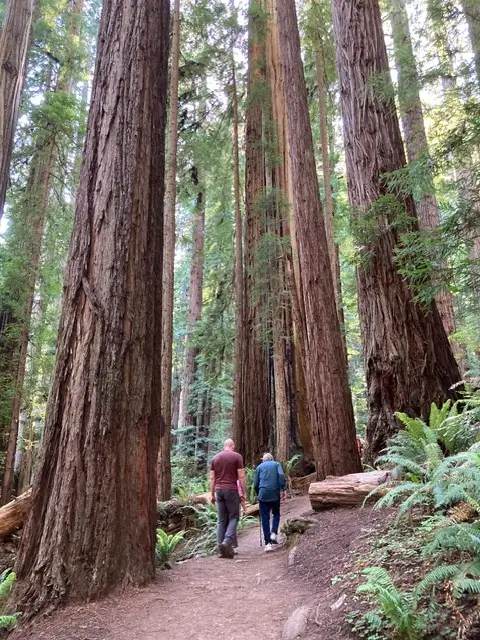
There is another community below the soil’s surface. The living Redwoods, as well as the other plants, depend on decaying plant and animal material around it. Banana slugs and as many as 700 other species are constantly feeding on the plant or animal litter they come upon. Their actions, combined with fungi and bacteria, help the decaying process, creating essential nutrients that will in turn feed the living plants, continuing the cycle of life.
Never can one event happen within the forest without it affecting other parts of the forest. The simple act of walking through an undisturbed area will change it. – Ron Jones
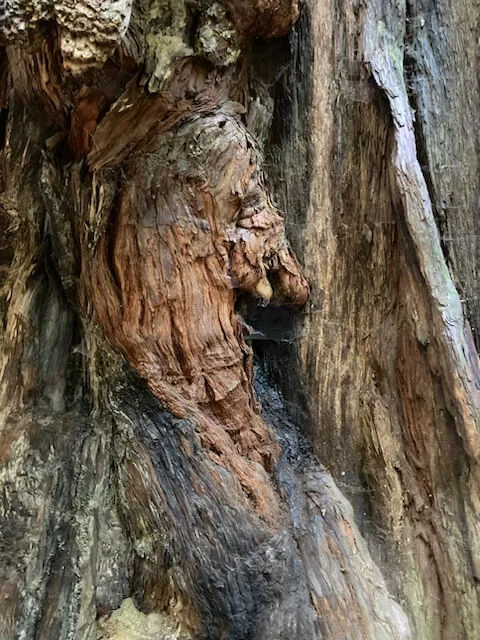
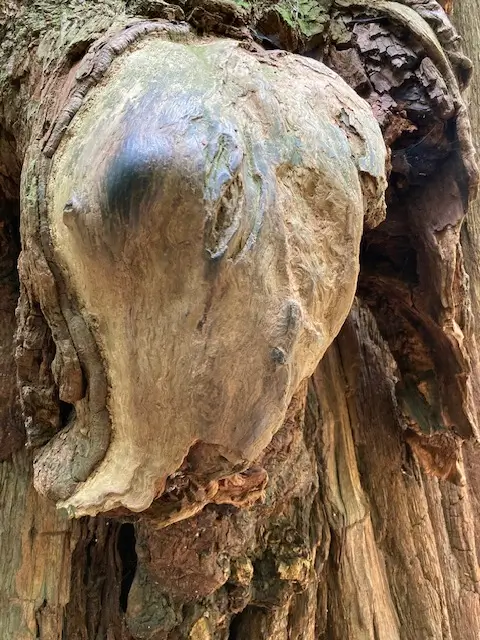
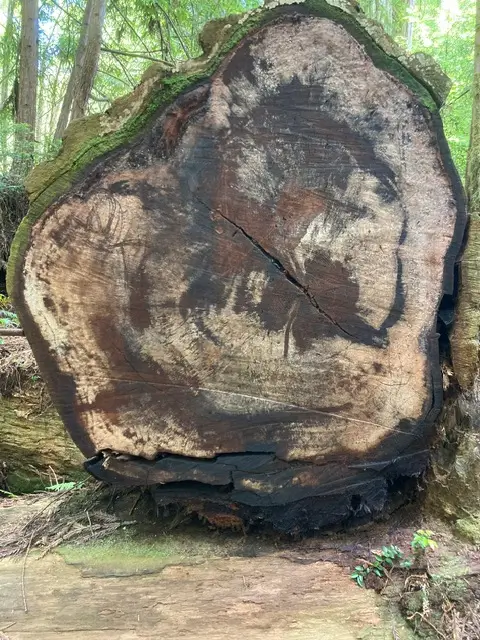
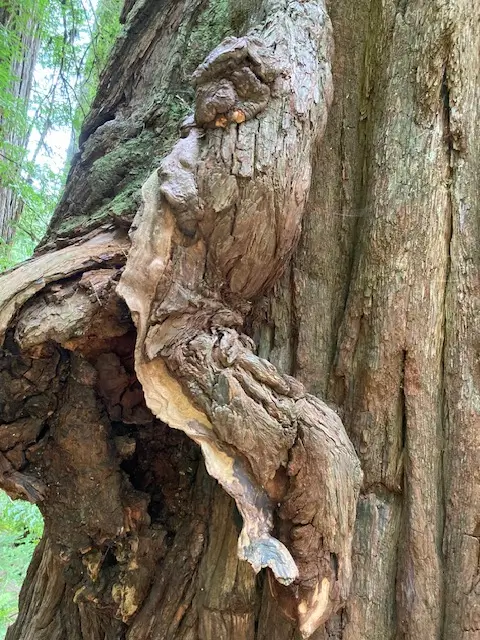
The eclectic artist in me sees sculptures everywhere, and Redwoods are no exception! Sometimes, nature provides the best sculptures.