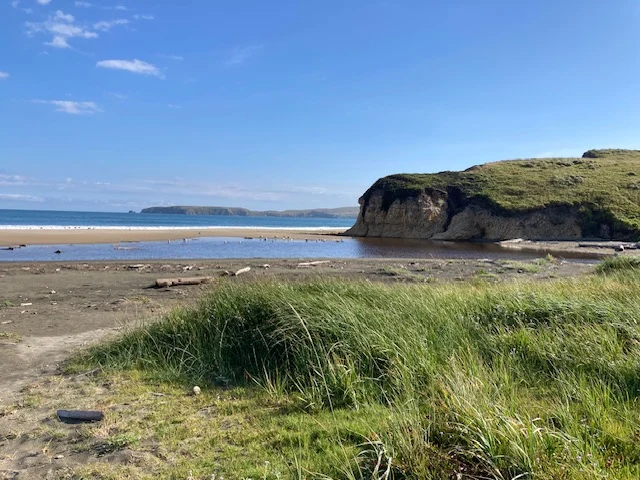

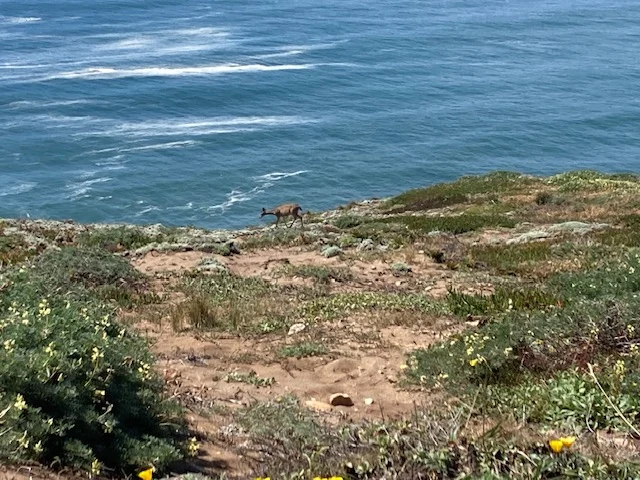
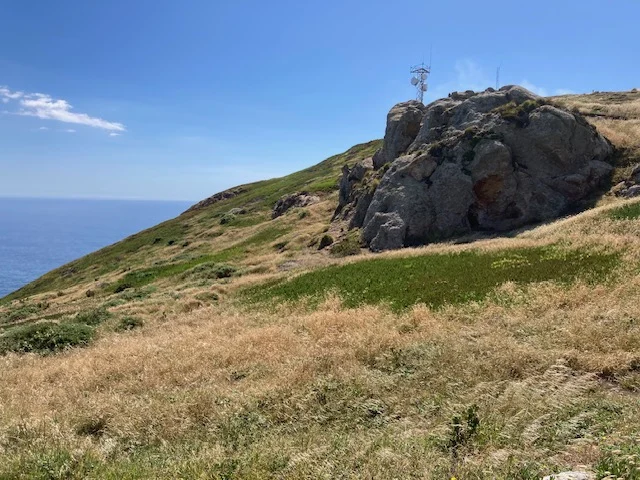
The rolling landscape leading to cliffs and sharp inclines reaching down to the ocean reminded me of the Irish landscape I often saw in movies when I was growing up, or the English coastline in movies depicting Robin Hood’s return to England. That being said, there is a much wider range of habitats than just ocean coastlines in Point Reyes National Seashore. It includes estuarine areas where the fresh water from streams and rivers mixes with ocean water. This brackish water has a high biodiversity and is a productive ecosystem in and of itself. Point Reyes also encompasses grassland and upland forest. Together, these provide for a variety of species, many of which migrate through the seashore annually.
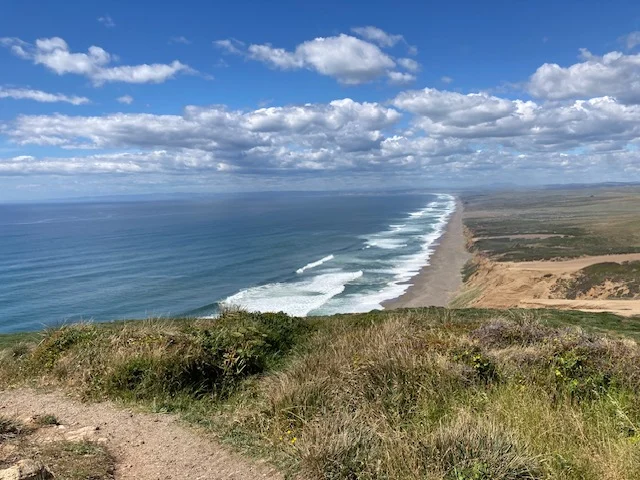
I’ll have to admit, when I went to the visitor center I was not expecting the dense upland forest surrounding it. Point Reyes covers more than 72,000 acres that includes 80 miles of coastline. The curvy roads up into the hills and through the forest were a surprise. Driving the 20-mile winding road to the lighthouse took about 45 minutes and wound through a variety of landscapes.
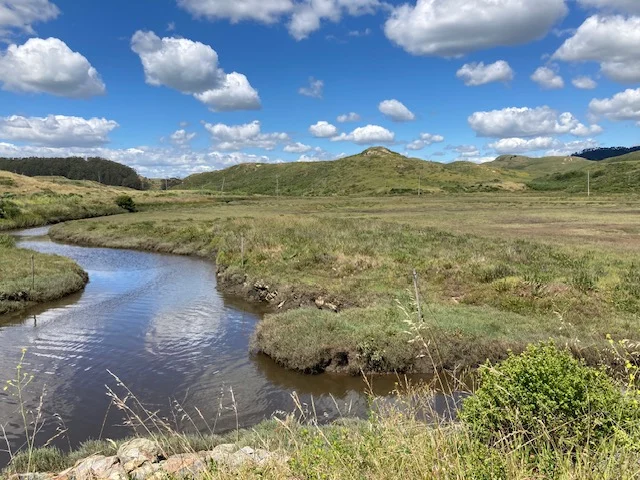
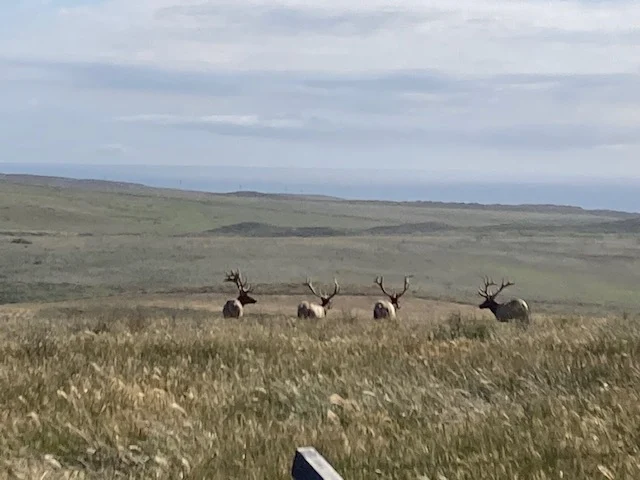
Humans have used the land for thousands of years. The Miwok people were there long before the first English explorers arrived in 1579. Over the centuries, waves of settlers seeking to make a life came, and by the 1800s the land was used primarily for ranching and hunting. The Tule elk were once hunted nearly to extinction. Their numbers have grown again, and I had the privilege to see a small herd! Leaving the coastline, intending to drive the hour out of the park, I took a right turn to Drakes Beach to use the facilities. Boy am I glad I did! At the top of the rolling hills, a small herd of Tule elk with huge racks were crossing the road, watching me as I slowly inched my car forward. By the time I stopped close enough to take a photo…. Well, you get the drift.
The threat of developers encroaching on the relatively undeveloped coastline areas in the mid 1900s spurred conservation organizations to fight to protect the area. Point Reyes National Seashore was authorized by Congress in 1962.
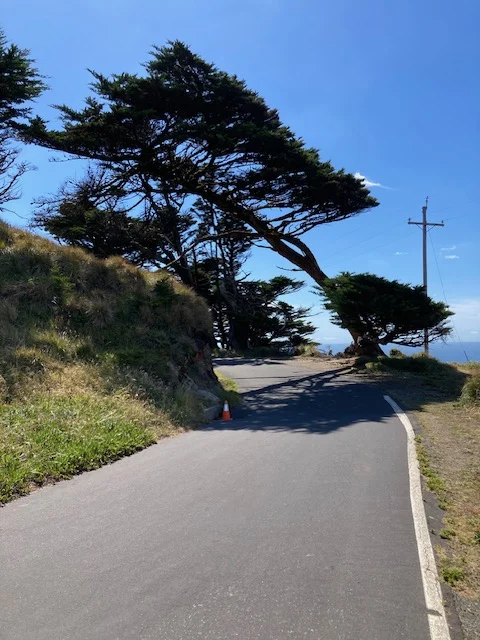
From the visitor center, I drove straight to the Point Reyes Lighthouse with only a quick stop or two along the way. I wanted to step into the piece of 1870 history before it closed. It is a quarter-mile walk from the parking lot to the lighthouse and the U.S. Coast Guard lifesaving operations buildings. The coastal views on this walk were spectacular, as was the evidence of the ocean wind sculpturing trees.
Once I reached the buildings, there were 313 stairs to get down to the lighthouse.
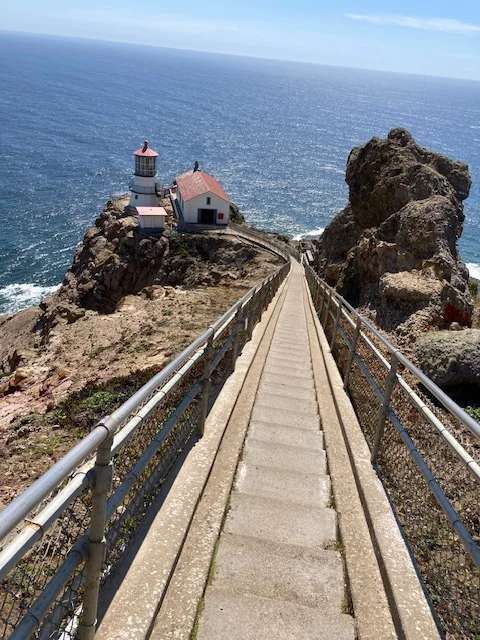
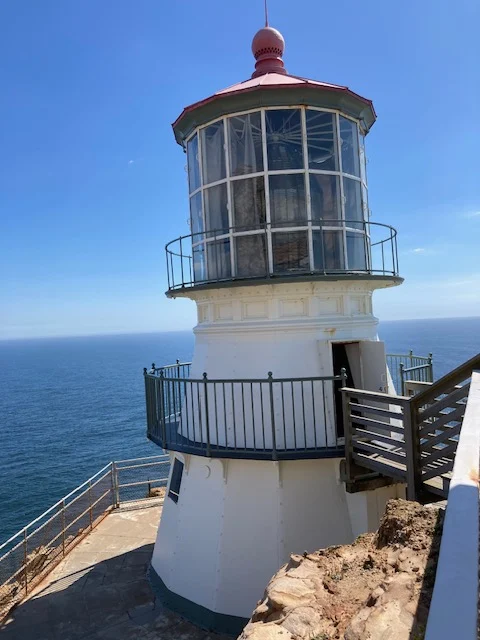
The lighthouse is a fascinating piece of history. After it was built in 1870, for 69 years the light was controlled by huge counterweights, like a grandfather clock, that had to be reset every 2.5 hours. Can you imagine having to get up every 2.5 hours to reset the counterweights? Doing that with a newborn baby has an end in sight, but this went on for 69 years. Once electricity arrived at Point Reyes, a motor was installed. The lighthouse was decommissioned by the Coastguard in 1975 and a new automated light was installed adjacent and below the historic tower.
Another hike I took was to the Elephant Seal Overlook. Watching these amazing creatures through binoculars, and listening to their sounds, was incredible. The colony stretched out on the beach like a box of fat match sticks dropped ready for pick-up-sticks. Some were cradled together, like spooning, others were laying by themselves, and others were on top of each other, or crawling over each other. Most seemed to be napping, but some seemed to need to make their presence known. The unique vocalization didn’t appear to be challenging, just communicating.
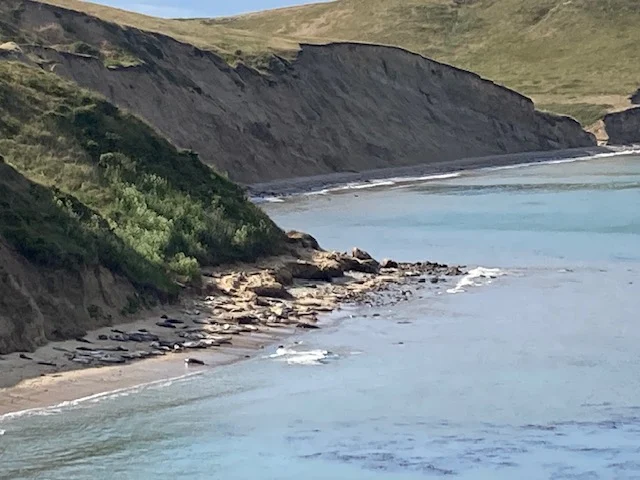
Drakes Beach was the only place I got down close to the water. The views off the cliffs, and of the cliffs, were amazing. It was my first taste of the Northern California coastline.