

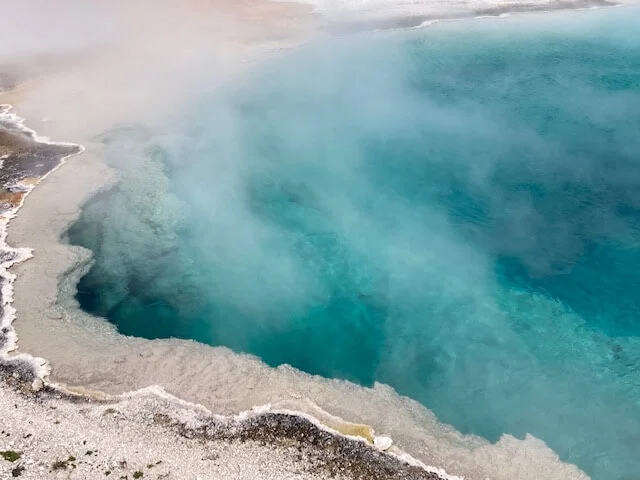
Geysers, mountains, rivers, falls, lakes, wildlife. A huge variety fills the roughly 50-by-60-mile rectangle that crosses the Continental Divide and makes up Yellowstone National Park. Yellowstone, the world’s first national park, was established in 1872, even before the surrounding states became part of the Union.
Driving into the park through the east entrance, one would never know a great volcano is bubbling underneath, and that the center of the park is a huge caldera, the collapsed crater of a super volcano that has been erupting for about 16 million years. The most recent was 640,000 years ago, which is the one that left the caldera measuring about 30 by 50 miles. What is interesting to me is the first eruption actually took place in what is now southeast Oregon. The volcano didn’t move. The entire continent drifted over a stationary plume of magma that erupts periodically.
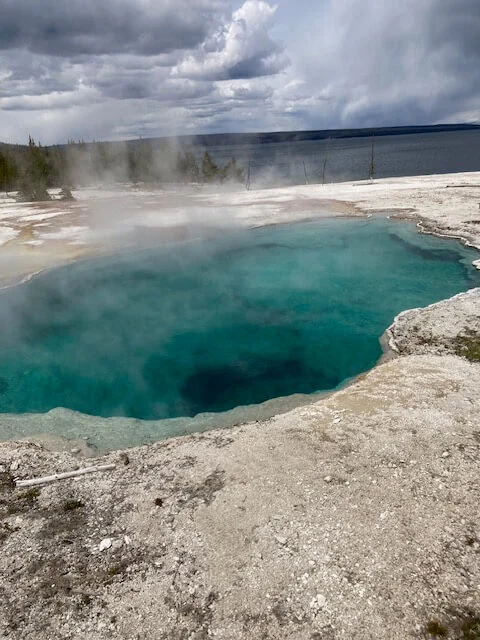
Because of the volcano under the park, Yellowstone has the world’s largest concentration of geysers and hot springs. Though I didn’t visit the area this trip, the Devil’s Mouth Spring in the Mud Volcano area creates a fascinating, scary, other worldly, growl. It is as if the volcano monster below is warning that he is not done yet. But it is impossible to predict if there is a chance that he will explode in the next century, or even 1,000 years from now. No one knows.
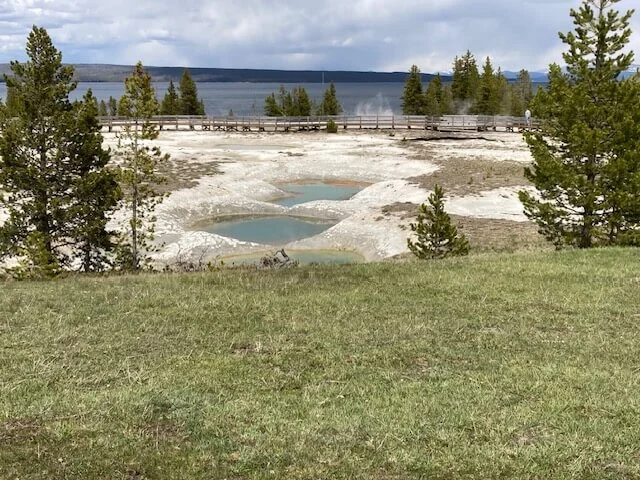
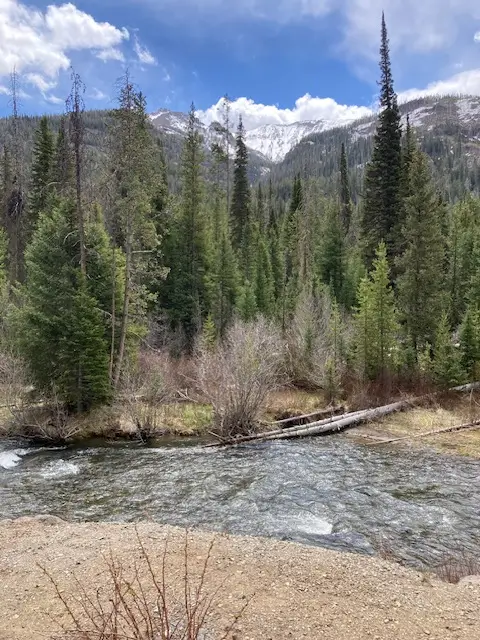
I had visited the park twice before, so my main goal was to drive through Yellowstone on my way west, and pick up a token. Well, I ended up spending the day there. No surprise I am sure! The mountain vistas, the lakes, the creek meadows all called for me to stop and soak in the beautiful area. The fantasy-like sky drew me into a story of someone draping filmy clouds, like a scarf or ribbons, around the snow covered mountain tops. Then a black barge of a cloud floated through like a barge on a river.
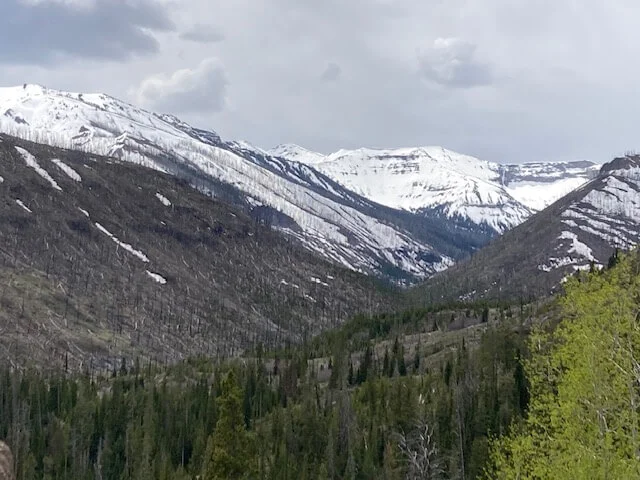
The sky changed consistently, from overcast fantasy clouds, to cloud speckled sunny blue sky, and the waterfalls were raging from the spring melt on the snowcapped mountains. Water also gushed out of stone along some of the roadways, and small waterfalls were in crevices.
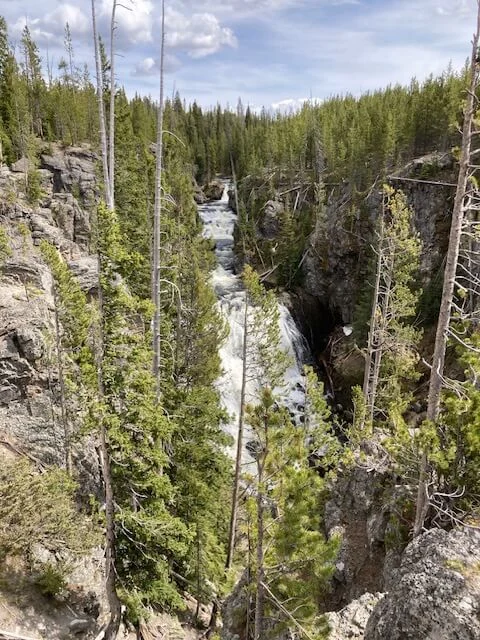
Kepler Cascades
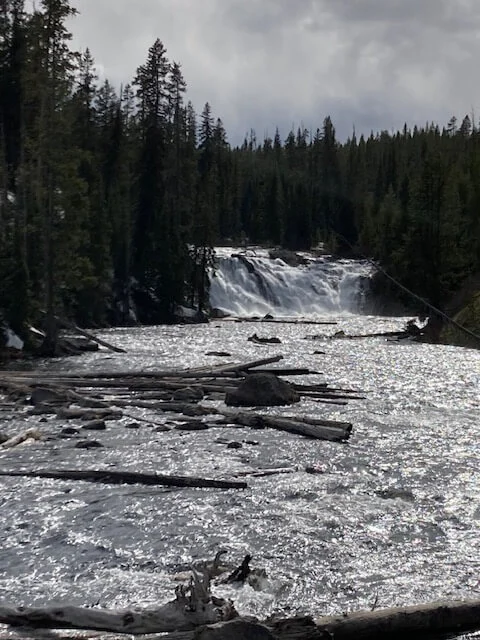
Lewis Falls
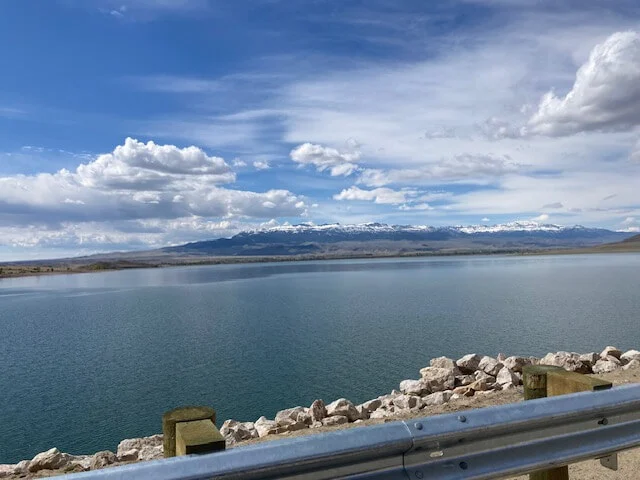
Yellowstone Lake
The variety of wildlife is one of the big draws to visit Yellowstone, especially the bears. I did see two grizzlies in a small meadow protected by a stone cliff. They were beautiful, but I wasn’t able to stop and watch. Both sides of the road were lined with cars and people, and the side closest to the bears had people sitting on blankets and in chairs, and lots of cameras. I could have parked a distance away and walked, but I didn’t. In a way, it was good the area was so busy with people. It gave me the excuse and opportunity to inch by slowly so I could really see them, take a photo in my head. I am finding that is where a lot of the memories of this trip are ending up, as photos in my head.
Sometimes, you don’t see any wildlife, but this trip was not one of those. I was blessed with the opportunity to see bighorn sheep, bison, geese with babies, a crane of some kind whose beak reminded me of an ibis, a variety of birds, and a gorgeous fox. I parked in a pull out facing Yellowstone Lake where I could enjoy the view while eating my lunch. He came out of the tall pine woods on one side of the pull out, trotted along the lake shore and then disappeared into the woods on the other side. His long bushy tail looked white or pale tan to me, as did the majority of this body, though the reds and browns were sneaking through. It was a privilege to be there at that moment, and I was the only one in the pull out.
I drove about half of the bottom of the figure 8 loop, entering from Cody on the east and then backtracking to the road going out the south entrance toward Grand Teton National Park. A person could spend days in Yellowstone.