

When you think of a petrified forest, do you think of a painted badlands? I didn’t, but that is what I found at the Petrified Forest National Park. Unexpected, but beautiful! Those of you who know me well, know how I feel about trees and how they feed my soul. That said, there was no question I would have to visit the petrified forest.
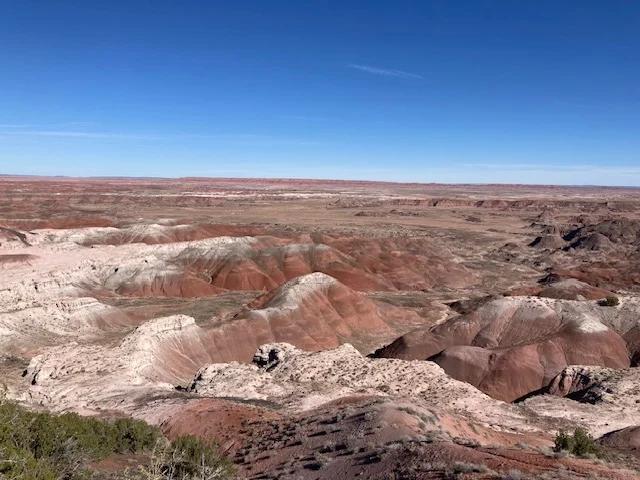
Petrified Forest National Park actually has two sections with a 28-mile scenic drive that connects them. The northern section, which is where I started, has a painted desert, with canyons stretching through striped mound of geological badlands. It is gorgeous!
The Petrified Forest was declared a national monument in 1906, and the Painted Desert was added in 1932. It wasn’t until 1962 that whole monument became a National Park. The legislation for the National Park was actually approved in 1958, but didn’t get signed and finalized until four years later.
There are a lot of overlooks along that 28-mile route, especially in the Painted Desert! Of course I had to stop at most of them. I had begun to think I had seen enough because I really wanted to get to the petrified forest, and then WOW! I had to stop at the next overlook. Each overlook view was different. There are areas where the sands are more blue, black and white, areas where the colorful mounds stretch farther than others, areas where the overlook actually stretches out into the canyon a little, and areas where the mounds look like pyramids.
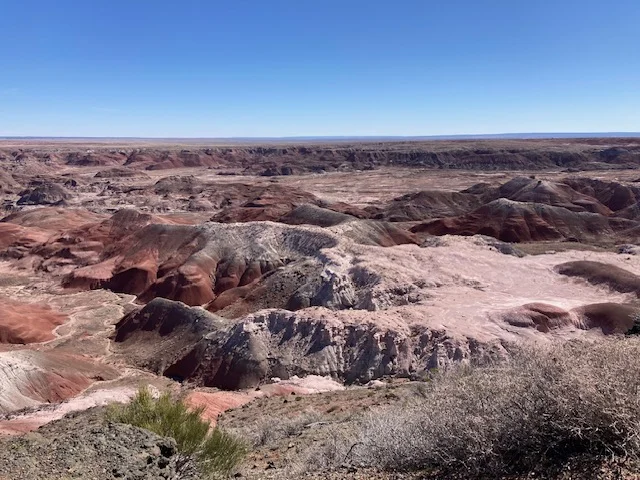
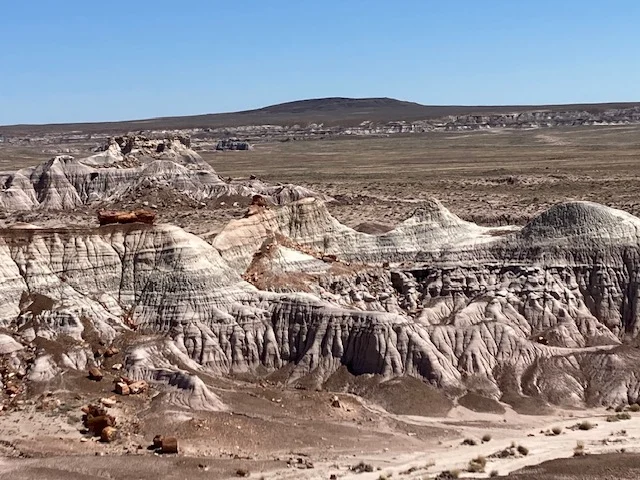
It is magical!
At the second overlook I found a steep switchback trail that leads down to the floor of the canyon. I am really cautious when traveling alone, but I pushed past my comfort zone and hiked down to the bottom. Wandering through the canyon floor gave me perspective of how deep the canyons really are. I also found petrified wood, and got close to areas I could see from the overlook.
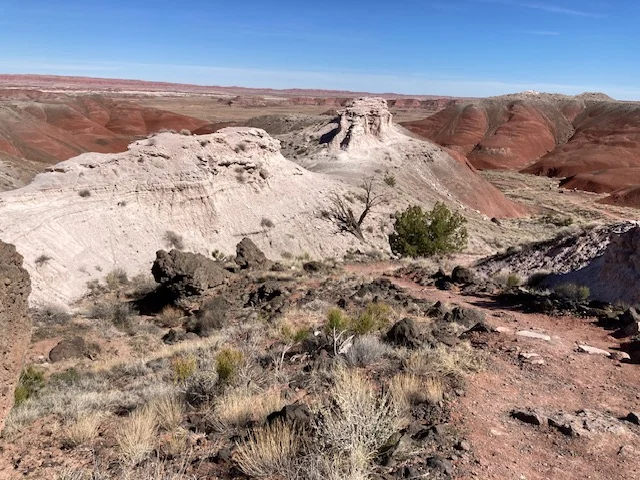
i actually stood in between the white mounds in this photo.
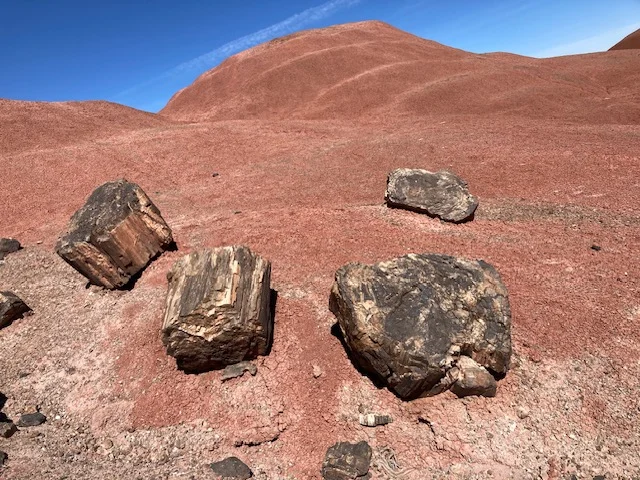
Pieces of Petrified wood in the canyon. They are much bigger than they look.
There are several different forests in the Petrified Forest section of the park – Crystal Forest, Jasper Forest, Rainbow Forest. I was amazed at the variety of colors created as the logs turned to stone! The Petrified Forest National park has one of the greatest concentrations of petrified logs in the world. The park also houses fossilized remains of some the earliest dinosaurs and more than 80 species of animals and plants. It also includes human history going back 13,000 years, and there are ruins and petroglyph sites dating back 1,000 years. An example of those petroglyphs can be seen at the Newspaper Rock overlook. If you visit, be sure to take binoculars to see the individual markings easier.
Hiking into the Jasper Forest, I met Trevor, a young man in his 20s. We bonded over the colorful, magnificent petrified wood shards on the ground, talked about his hike farther into the Jasper Forest, and compared notes on National Park visits. The ground where we met was littered with smaller pieces of petrified wood that had chipped off the logs over time. The rainbow of color reminded me of the shell shards littering a beach.
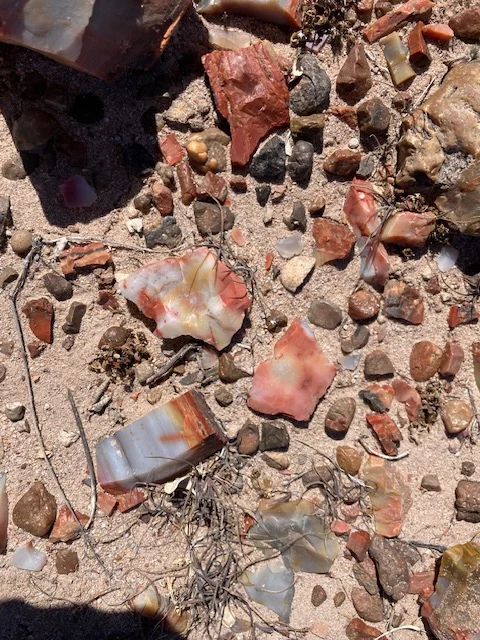
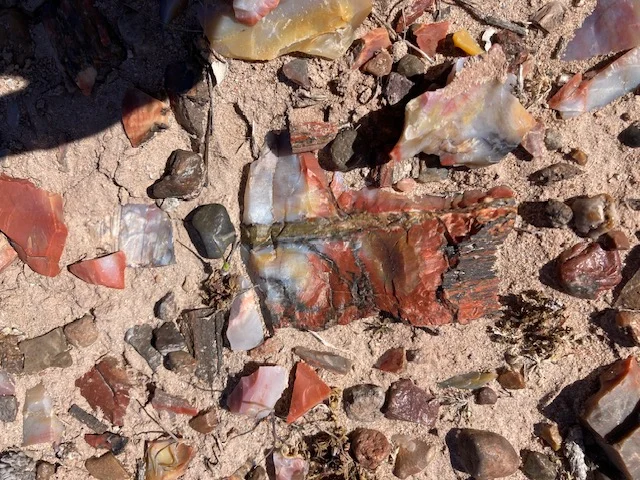
The forests are actually deserts with logs laying around. One woman was not impressed. “I don’t get it! It looks like a bunch of cut wood!”
I disagree. Yes, it looks like a lot of cut down trees and logs, but if you stop long enough to really see them, the kaleidoscope of color jumps out at you. And they are no longer wood. In my understanding, it took millions of years for the trees to get to where we see them today. Floods felled the giant trees and trapped them in channels where they settled into a slurry of mud, sand and volcanic ash. The various chemicals released from the slurry reacted with the wood, turning it to stone. Different chemicals in the slurry created the colors – white from pure silica, black from organic carbon, blues and purples from manganese dioxide, red and pinks from hematite, greens from iron mixed with chlorophyll, etc.
The logs were covered with more mud and silt over centuries, protecting them from decay. Then the movement of tectonic plates and uplifting of the ground moved them up to their current location where water and wind erosion exposed them, allowing us to see them today.
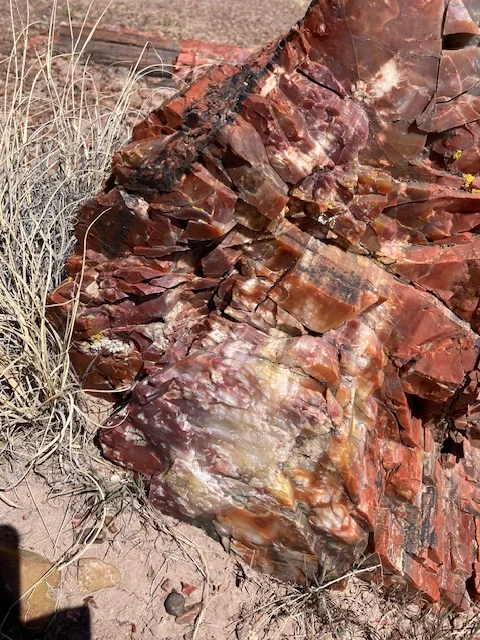
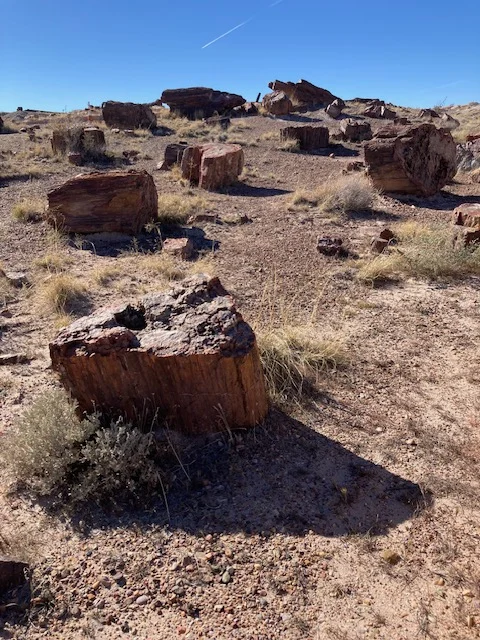
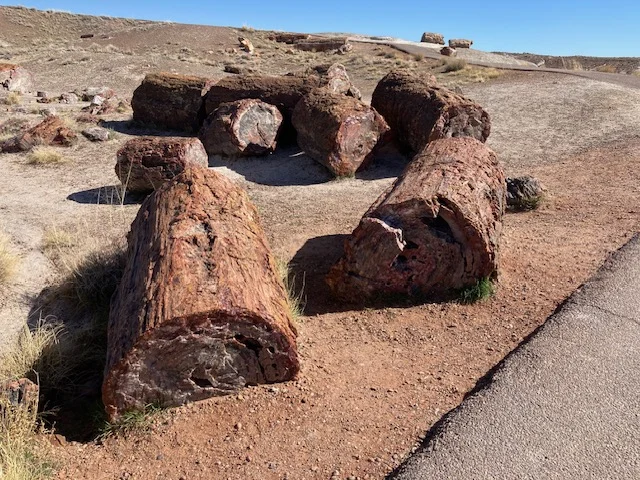
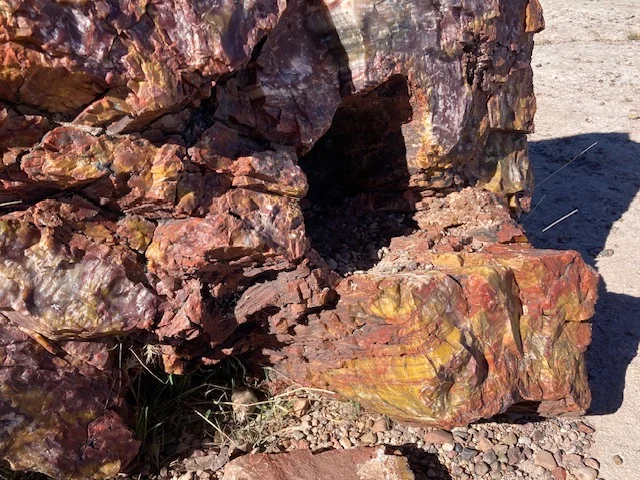
It’s hard to tell the magnitude of size with these photos. Some of the logs were longer than I am tall and, and lying down some were up to my waist or as tall as I am. It was phenomenal to be near these wonderful rocks.
You can tell from the photos that I was fascinated with the colors. It amazes me how wood, over time, can become these colorful pieces of stone. I sure love the way God paints.