What is it about water that draws a man? (Man meaning human.) I once created a book ruminating on that question for my mother-in-law who lived on a lake. It is a question with as many unique answers as there are humans.
For me, the answer is simple: freedom, sustenance and support. There is a freedom I feel when in the water, freedom of movement, and freedom from stress. And the whole body gentle pressure seems to align everything.
Then there is the sustenance, not only for the physical need of water, but also the power of its beauty and the pull of curiosity to investigate under its surface.
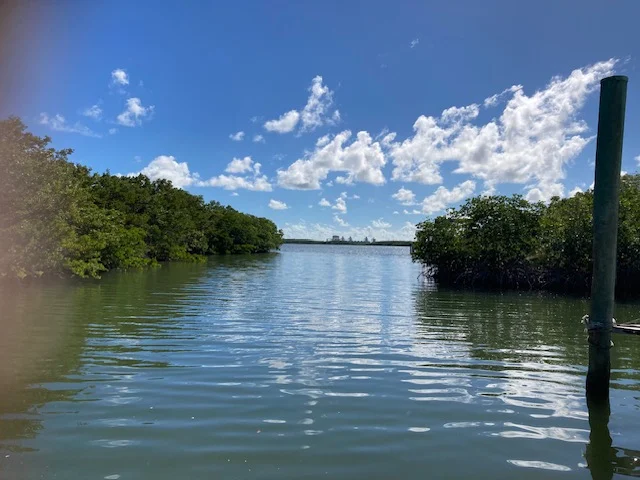
Last week, I had the opportunity to spend a day at Biscayne National Park where 95% of its 173,000 acres is under water. The morning was spent snorkeling inside Biscayne Bay, and the afternoon was spent on top the water learning more about the park’s history and visiting Boca Chita Key.
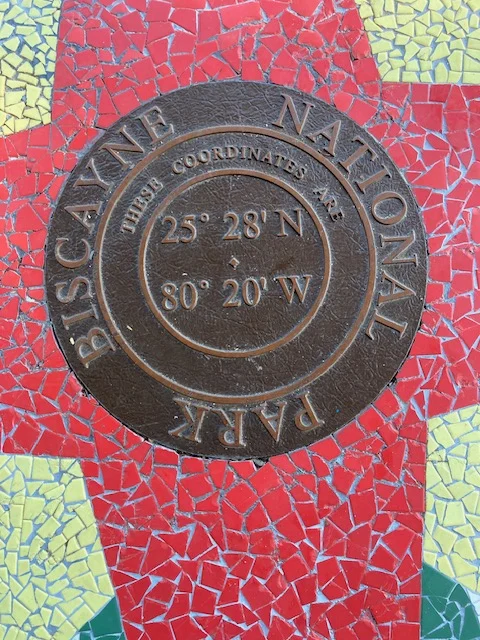
The snorkeling was amazing! We weren’t able to go to the reef on the Atlantic Ocean side of the keys because of the wind, which stirs things up obscuring visibility. But inside Biscayne Bay was incredible on its own.
I don’t know why people rush so when they are snorkeling. Maybe they are trying to see all they can, but I don’t want to miss a thing! I move slowly and study, and stay still at times to allow the fish to realize I am not a threat. I don’t have an underwater camera, though I would have loved to capture images of the interesting things hidden under the surface of the water. Though I may have been concentrating more on capturing images than enjoying what I was seeing….
At one point there was a school of tiny neon fish near me, as well as a school of yellow and blue fish that I believe are bluestriped grunts. I also spotted a conch shell on the bottom that was nearly the same color as the sand. The queen conch had its eyes stretched out of the shell until it spotted me and they quickly shrank back in. At first, I wasn’t sure what the black tentacle things were, but Natalie, the naturalist on our excursion, explained those are the eye stalks, and the black paddle-like extension I saw is like their tongue. I saw many other fish including baby barracudas, cowfish and trunkfish.
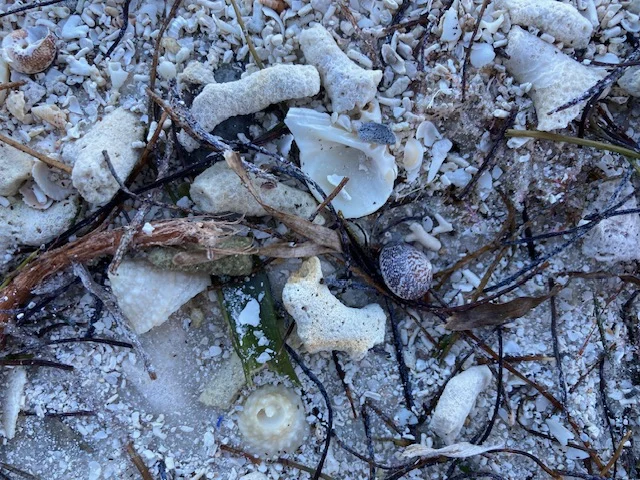
Interesting facts I learned: 1. Keys are different than islands in that keys are created on top of remnants of ancient coral reefs, while islands are created by volcanoes, or tectonic plates shifting, or some kind of earth movement. 2. Mangroves occupy only about 0.5% of the global coastal area, but they contribute 10-15% of coastal sediment carbon storage globally.They can sequester carbon at a rate 10 times more than mature tropical forests. 3. Sea grasses contribute oxygen through photosynthesis. While snorkeling, I was able to watch the tiny bubbles rise from the sea grass. It was totally a mermaid moment.
The afternoon boat tour gave me more information on the history of the park and the influencers who helped it remain more in its natural state. I found it interesting that there was a plan to develop the keys around Biscayne Bay, connecting them by road to Miami, which would have changed the ecosystem dramatically. The plans included dredging a canal through the shallow bay. I’m glad preserving the area won the debate, and Congress created the Biscayne National Monument, with the bill signed by Lyndon B. Johnson in 1968. It gained National Park status in 1980.
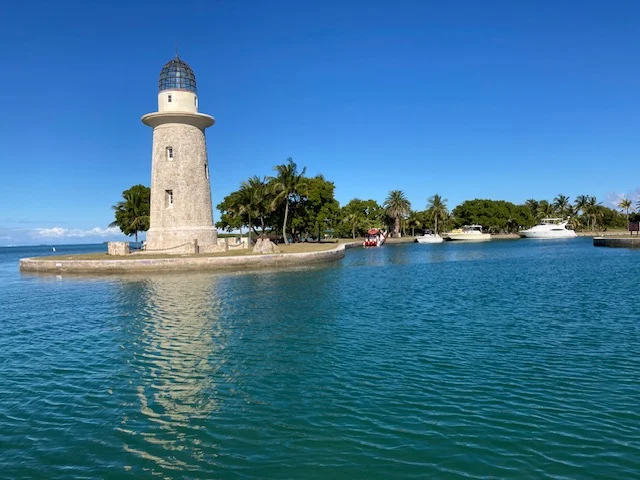
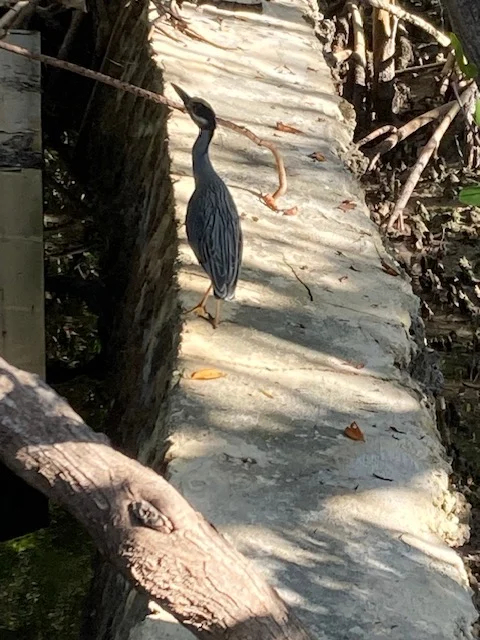
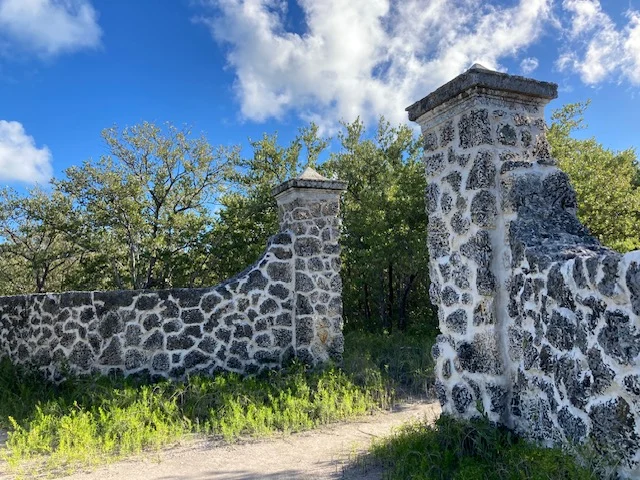
We stopped at Boca Chita Key for about an hour to investigate the small key. It was owned by millionaire Mark Honeywell in the 1930s where he hosted lavish parties. He constructed a lighthouse, a small church, a four-stall garage to show off his cars, and a main house. The lighthouse was never sanctioned by the coast guard, and he added a cannon to announce arrivals to the parties. The lighthouse, church, four-stall garage, a wall and foundation remains are still on the island. There is a half-mile trail through the natural areas.
I’m so glad I had the opportunity to spend the day there! I recommend visiting this national park if you ever have the opportunity.