I never imagined I would end up having lunch with horses. I mean, I didn’t get up that morning thinking I would be eating with them. Packing my backpack to catch the ferry to Cumberland Island National Seashore I was hoping to see them, but who would have thought?
I had been trying to visit Cumberland Island for the last couple of months, but during the government shutdown in November the ferry to the island, as well as the visitor center, was shut down. I finally made it the weekend after Christmas.
The fog and mist formed an envelope around the ferry that followed us the 45 minute ride out to the island, hiding most things from our view. As we got closer to the island, it lifted enough for us to spot a couple of horses on a nearby island.
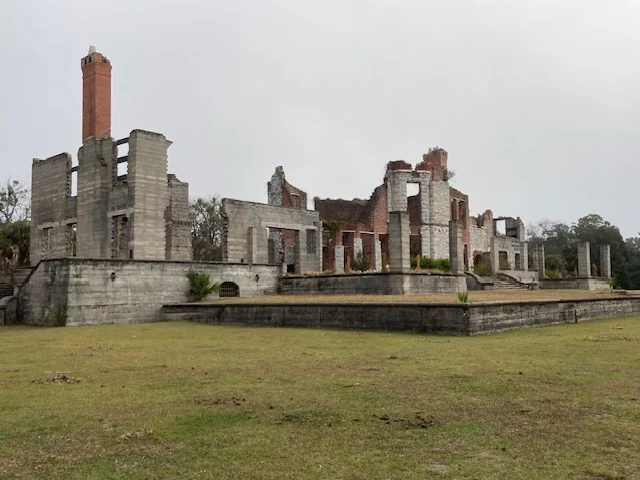
Cumberland Island has over 50 miles of trails and roads, and several historic buildings and areas to investigate. The images I saw of the Dungeness ruins intrigued me, which was the main reason I wanted to visit, as well as the wildlife.
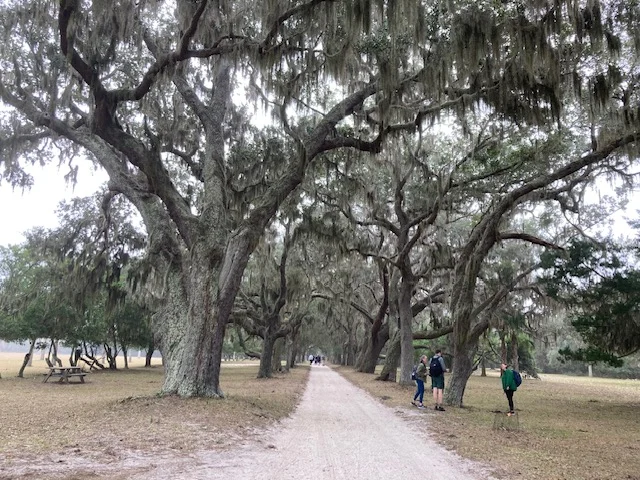
As I stepped off the ferry, the island map became my best friend. Marveling at the peace that fills me when I am outside in the woods, I gathered my bearings, followed the sandy road and began the half-mile trek to the ruins.
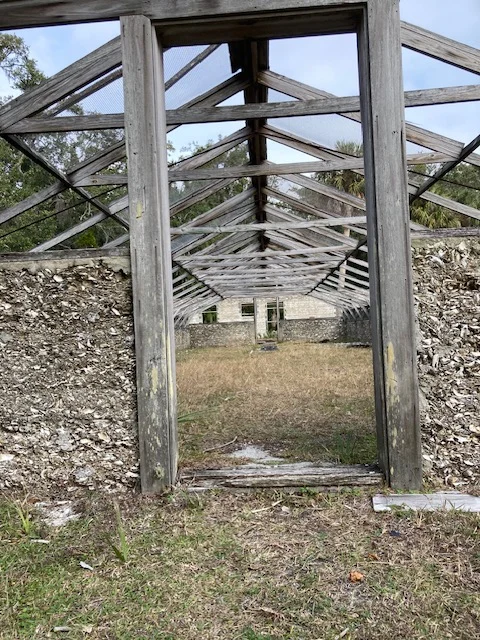
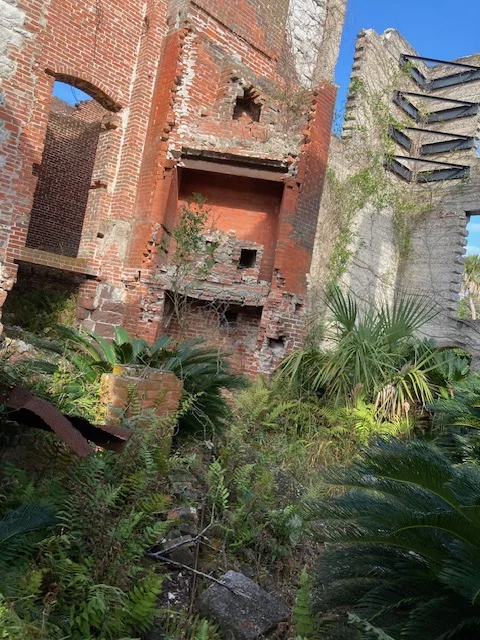
The first home on the property was started by the Revolutionary War hero Nathaniel Greene and his wife Catherine. but he died before the home was completed. Catherine Greene and her second husband, Phineas Miller, built the first Dungeness Mansion in the early 1800s, which burned down in 1866. Thomas Carnegie purchased the property and began the construction of the next mansion, which was also named Dungeness, in the early 1880s. It was meant to be a winter home for Carnegie, his wife and their nine children. Though Carnegie died shortly after the home was complete, his wife, Lucy, continued to spend more time on the island property. She pumped more resources into the estate with additions and remodeling over the next 30 years. By the time she died in 1916, the mansion had grown to about 35,000 square feet. Sadly, it caught fire in 1959 and only the brick and stone walls remain.The ruins also include the bones of a greenhouse that, along with what once was large gardens and livestock, served to keep the family self sufficient on the island.
I love learning about the history of areas and about the people who came before us, how they lived and how decisions and interactions changed the path of the future for many. I soaked in the history and the nature as I walked down the tree-lined road that led to a once thriving golden era estate. I was able to take some photos all around the ruins as the fog lifted, looking for wildlife as I went.
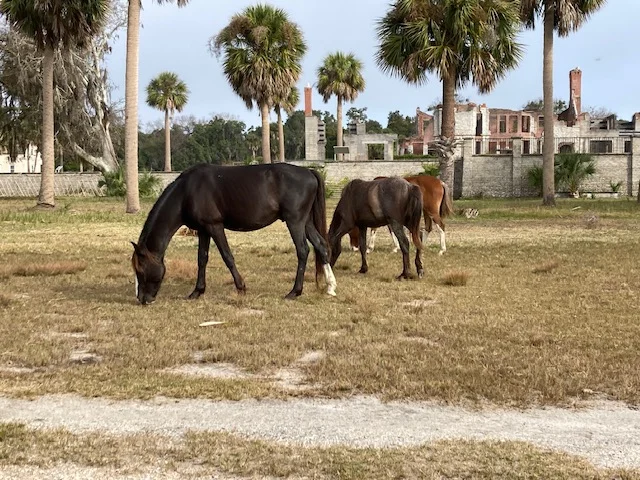
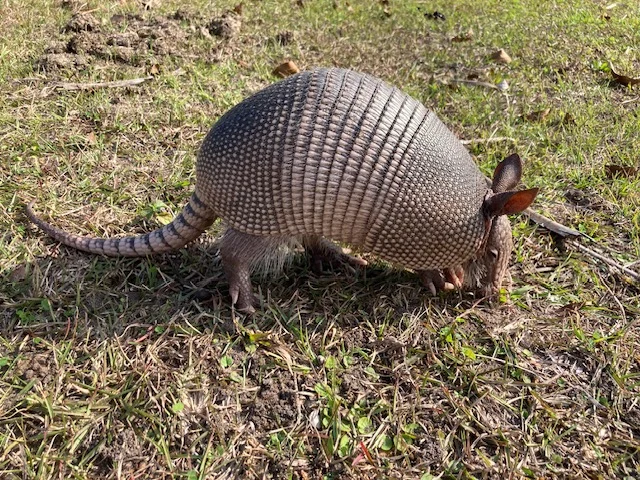
The first wildlife I spotted was an armadillo, who didn’t seem to care there were people around. He kept on scrounging and nuzzling the ground looking for tidbits to eat. Next I saw three horses lazily grazing along near the shore behind the ruins. As I was moving around the the other side of the mansion, there was another armadillo scavenging through the grass. I stood still to take a few photos and he kept moving closer to me. You’re not supposed to go near or touch the wild life and there are recommended distances from them you are supposed to keep. I guess he didn’t care, so I stood still and he came within a couple of feet from me. I have never been that close to one in the wild, and I loved seeing the strips on the tail, the little hairs jutting out below the armor near his neck and his face.
Moving on, I checked out the ruins of the recreation building. It’s amazing that a recreation building was needed to augment a 35,000-square-foot mansion! Anyway, I also wanted to walk the salt marsh boardwalk and was attempting to find it after circumventing an area closed for renovations when I spotted three horses – a male, a female and a colt – grazing behind a building with a utility lot. I stood in the middle of the lot watching them and taking photos when my phone died. I stayed there for a long time, and the mare finally slipped between me and the building and entered the building’s courtyard to graze. I didn’t realize until I stepped out of the lot, crossed the sandy road and sat at a wooden weathered picnic bench that I had actually been in the way. The three horses moved across the lot and started grazing in a small patch of grass across the road from me.
Deciding to stay and watch the horses for a while, I pulled my lunch out of my backpack. The horses moved across the road and were grazing the grass near the picnic tables, and the male kept inching closer to the tables. I never imagined I would be eating lunch with the horses! And I was unable to capture it because my phone had died! It was really a privilege. I could see a couple more horses across the lot in the woods, and a man, who was probably about my age, came up a path behind the lot. He was photographing the horses near me and as he got closer tot he picnic table he said, “the best part of the video is you eating lunch with the horses!”
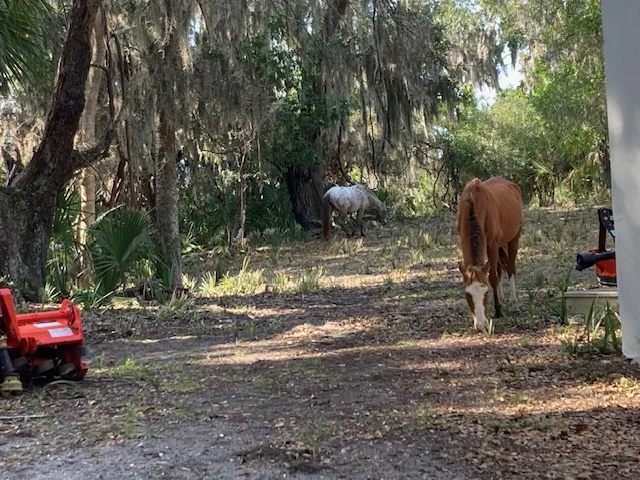
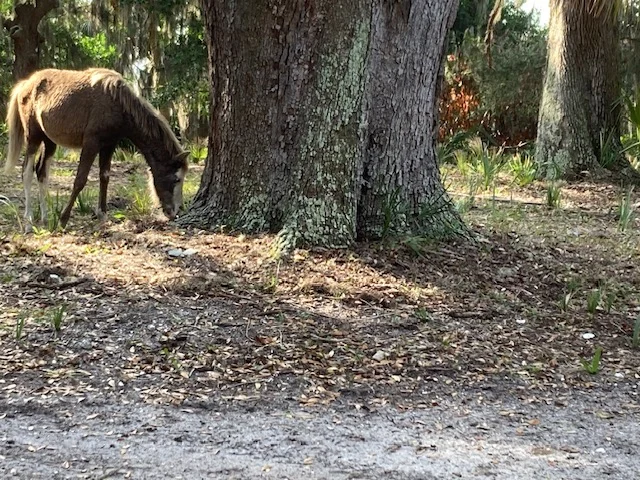
The male horse kept moving closer and then circled behind me. I had no idea what he was going to do. When he got to the other side of the tables (there were only three, and I was sitting on the middle one) he stopped and snorted. Then he stopped in the road right in front of the tables and whinnied loudly. The horses in the wood emerged and once the group was all together, they trotted away down the road. To me, it was like he was calling his herd together to move on. The whole interaction was quite surprising, and wonderful! From the time I spotted them to the time they trotted down the road must have been around 45 minutes. It was the best lunch, though the food wasn’t anything special, and it sure made my day!
I did find the board walk through the salt marsh, and I walked over the dunes to the beach before I headed back to the ferry dock. It was a wonderful seven hours filled with interesting sites, woods, dunes, people to talk with, wildlife and time on the water.